Dear colleagues – Directors of Educational and Research Institutes, Deans of Faculties, Heads of Departments, academic and teaching staff!
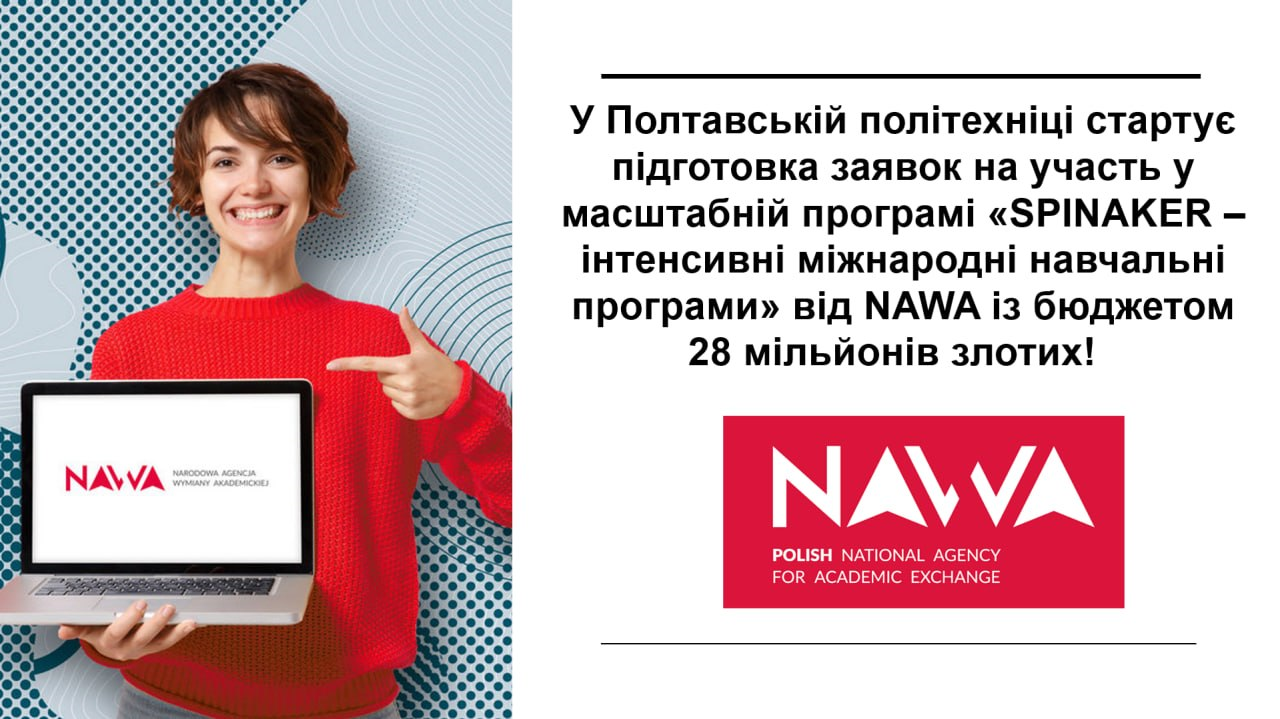
The Polish National Agency for Academic Exchange (Narodowa Agencja Wymiany Akademickiej – NAWA) has officially announced the launch of the call for project proposals under its flagship program “SPINAKER – Intensive International Curricula” (IMPK) for 2026!
This initiative provides our university with an outstanding strategic instrument to deepen internationalisation, modernise pedagogical infrastructure, attract international students and researchers, and scale our academic potential across the European Higher Education Area. Below is a detailed overview of the call, requirements for educational products, financial parameters, and the participation procedure.
The primary objective of the SPINAKER program is to significantly enhance the quality of the educational process and strengthen the reputational attractiveness of Polish scientific institutions and higher education establishments within the global academic community.
The European Union funds the call under the “European Funds for Social Development 2021–2027” (FERS) program via the NAWA project “Support for the Creation and Implementation of International Educational Programs”. The total budget of the current call is PLN 28 million, enabling support for the highest-quality and most innovative interdisciplinary educational initiatives.
Participating universities can transform conventional courses into modern international formats, integrate cutting-edge teaching methodologies, and systematically expand their partnership networks with foreign higher education institutions.
What is IMPK: Concept, Parameters, and Standards
The central object of funding within the grant is Intensive International Curricula (IMPK – intensywne międzynarodowe programy kształcenia). These are compact, targeted, and practice-oriented learning formats that must comply with a series of mandatory regulatory requirements:
Scope and duration: each program's workload must range from 20 to 150 teaching (didactic) hours. This allows for flexible formats: from summer/winter thematic schools to specialised intensive modules in cutting-edge scientific fields.
Language of instruction: the program must be conducted entirely in a foreign language (any language other than Polish). English is primarily used as the language of instruction; however, other foreign languages may be utilised depending on the specific nature of the academic field.
Composition of participants: a mandatory prerequisite is the inclusion in study groups of international participants – international students, doctoral candidates, or staff members from foreign higher education institutions and scientific establishments. Alongside them, students, doctoral candidates, and faculty members from our university and other Polish institutions may participate with equal standing, thereby creating a robust platform for productive intercultural dialogue.
Format and venue: all program activities must take place on Polish territory. At the same time, program regulations allow for both traditional on-site (in-person) and hybrid formats of instruction, enabling the flexible integration of online modules with laboratory or field practice.
Micro-credentials: course completion must verify acquired learning outcomes and be certified by awarding participants a standardised certificate or micro-credential (mikropoświadczenie) detailing specific attained competencies, in compliance with European standards for educational transparency.
Which Stages and Activities Are Eligible for Funding?
A key methodological requirement of the SPINAKER call is the project’s comprehensive nature. The proposal cannot be limited merely to the curricular development of materials or, conversely, to conducting classes according to pre-existing models. An application must integrate two interconnected stages: developing (or substantially adapting) the program and implementing it.
Within a single project proposal, academic teams may plan to develop several distinct IMPK programs or organise multiple editions (cohorts) of the same program for different groups of participants.
The project budget may cover expenses in the following areas:
• Methodological and pedagogical preparation: syllabus design, preparation of instructional manuals, digital content creation, adaptation of existing courses to the specific needs of an international audience, and implementation of innovative pedagogical technologies.
• Human resource development: professional development and upskilling of the academic and administrative staff of our university, aimed at acquiring competencies in designing and managing international educational programs.
• Recruitment and promotional campaign: preparation of informational materials, launching international outreach campaigns, and establishing a transparent competitive selection process for foreign participants.
• Educational delivery: remuneration of teaching hours, delivery of lectures, laboratory sessions, seminars, case studies, off-site educational workshops, fieldwork, and study visits.
• Social and integration module: organisation of intercultural workshops, integration events, study trips, and cultural activities designed to facilitate the adaptation of international guests.
• Quality assurance and certification: design of learning outcome assessment tools, final evaluation procedures, issuance of micro-credentials, as well as internal and external educational quality monitoring mechanisms.
Financial Parameters and Timeframes
Funding volume per proposal: the minimum funding amount is PLN 400,000, while the maximum grant amount can reach up to PLN 1,200,000.
Project duration: the direct implementation of planned project activities must span at least 6 months.
Implementation timeline: projects must be executed between June 1, 2027, and October 31, 2028 (with the overall program concluding on December 31, 2028).
Submission Regulations and Strategic Institutional Coordination
Application submissions are accepted via the NAWA electronic system (System Agencji) until December 3, 2026, at 3:00 PM (Warsaw time).
We draw the attention of structural subdivision heads to a critical competition condition: a single institution (higher education institution) may submit no more than two project applications in total.
This limitation demands a high level of institutional organisation and a strategic approach to project selection within our university:
Applications submitted on behalf of the university must demonstrate the highest level of academic maturity, a rigorously structured budget, and strong potential to recruit international participants.
Academic departments and faculties intending to establish a project team must promptly begin concept development and consult the university's International Relations Office.
The university will conduct an internal preliminary review of concepts to select and develop the two highest-ranked and most competitive applications.
Official Resources and Contact Details
Detailed call regulations, applicant guidelines, cost eligibility rules, and document templates are available on the official NAWA web portal: NAWA – SPINAKER 2026
Central Program Coordinator at NAWA: Bożena Kurek
Email: spinaker@nawa.gov.pl
We urge the leaders of our scientific schools and proactive faculty teams to use this mechanism to capitalise on their scholarly achievements, expand our international academic network, and secure substantial investments for our university's development!
For further details and assistance with application procedures, please get in touch with the International Relations Office: interoffice@nupp.edu.ua (Room 213-C) or the University's International Relations Coordinator, Anna Pavelieva (Tel.: +3-8-095-91-08-192).