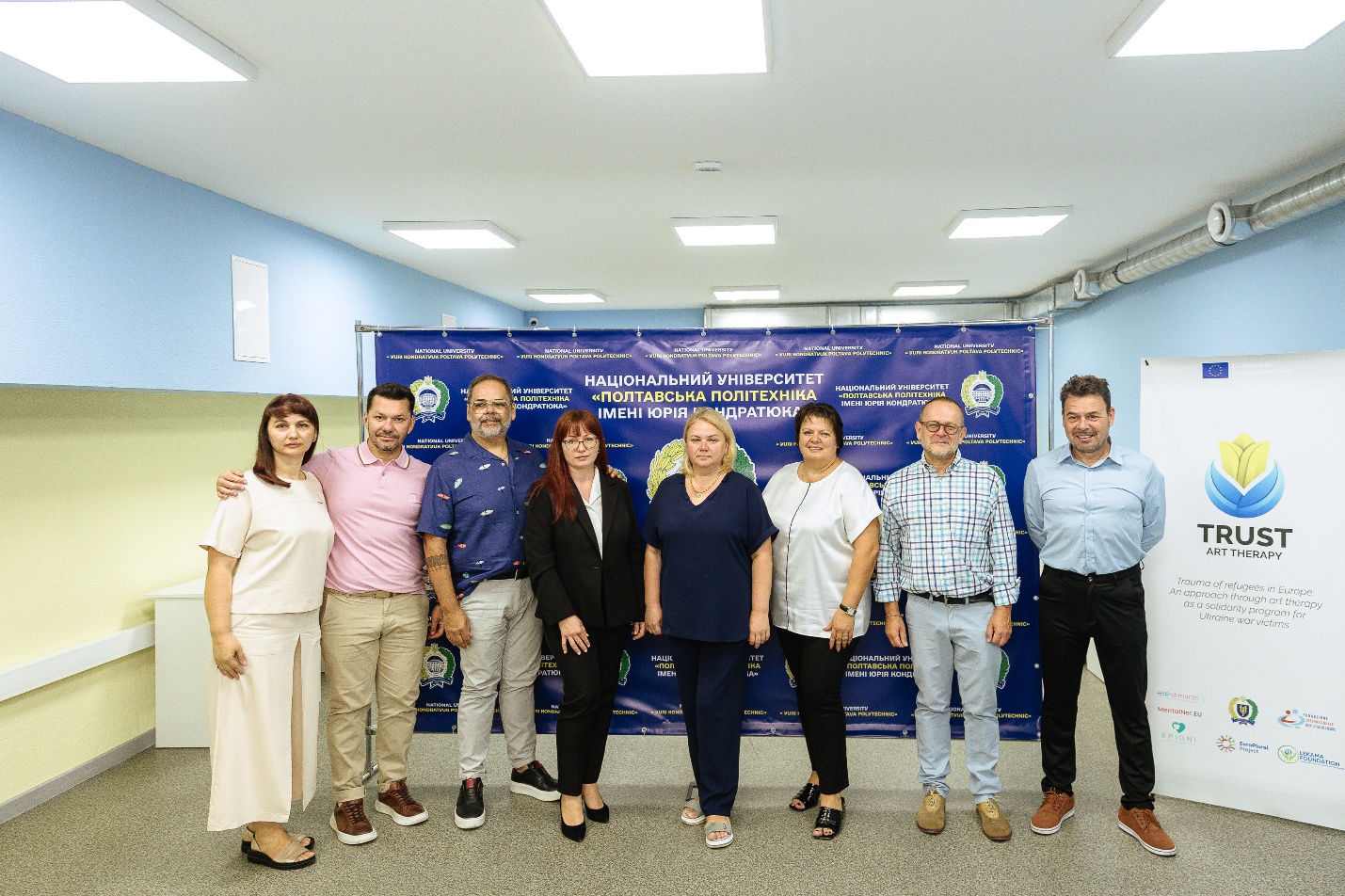
On August 31, 2026, National University “Yuri Kondratyuk Poltava Polytechnic” became the centre of an international academic and therapeutic dialogue. The university hosted the participants of the final major in-person transnational working meeting and the Steering Committee meeting within the framework of the prestigious international Erasmus+ KA220-ADU project “TRUST”: Trauma of refugees in Europe: an approach through art therapy as a solidarity program for Ukraine war victims (Grant Agreement No. 2024-BE01-KA220-ADU-000257527). This initiative aims to provide comprehensive support for Ukrainians affected by the war through culturally competent art therapy methods based on EU values.
The project title “TRUST” stands for the following:
T – Trauma
R – Refugees
U – Ukraine
S – Solidarity
T – Therapy
The project is co-funded by the EU and led by the Centre Neuro Psychiatrique St-Martin (Belgium), in partnership with Poltava Polytechnic (Ukraine), Greek Carers Network EPIONI (Greece), Fondazione Don Luigi Di Liegro (Italy), LEKAMA DEVELOPPEMENT (Luxembourg), and EuroPlural Project (Portugal).
This event was a key milestone as it was the final major in-person meeting of the project leaders before the initiative entered its final phase. Previous successful stages and partner meetings were hosted sequentially by other consortium countries – Luxembourg, Italy, Portugal, and Greece – while the meeting in Poltava allowed partners to analyse the results in detail, adjust plans, and discuss the strategy for preparing for the final stage.
The administration of Poltava Polytechnic warmly welcomed the international delegation and representatives of partner organisations. Welcoming remarks were delivered by the Vice-Rector for Scientific and Research Work of Poltava Polytechnic, Doctor of Technical Sciences, Professor Olena Stepova, and the Dean of the Faculty of Philology, Psychology, and Pedagogy, Candidate of Pedagogical Sciences, Associate Professor Anna Ageicheva, who emphasized the deep solidarity of European colleagues with the Ukrainian people and the importance of scientific and practical cooperation in the crucial field of mental health. They noted that for Poltava Polytechnic, participation in the design and implementation of “TRUST” is not only a scientific and educational duty but also a significant social mission, enabling effective support for higher education students, faculty members, internally displaced persons, and veterans in need of psychological assistance.
Key figures of the “TRUST” project actively engaged in productive discussions and planning. Among them were Claudio Marques, the Project Manager, and Jocelyn Deloyer, a psychologist and leading specialist in European projects, representing the lead coordinator, the Centre Neuro Psychiatrique St-Martin from Belgium. The meeting was also attended by partners from Portugal representing the Associação EuroPlural Project: Dr João Alves Neto, a psychiatrist, and Rubielson Medeiros, a director and specialist in choreography and dance therapy.
Additionally, European colleagues from Greek Carers Network EPIONI (Greece), Fondazione Don Luigi Di Liegro (Italy), and LEKAMA DEVELOPPEMENT (Luxembourg) also participated in the meetings remotely via Zoom.
Organizational support, a high level of preparation, coordination, and hosting of the meeting at the university were ensured by the local coordinators and researchers of Poltava Polytechnic – PhD Anna Pavelieva, university’s International Relations Coordinator, Candidate of Philological Sciences, Associate Professor, and Maryna Teslenko, Candidate of Pedagogical Sciences, Associate Professor of the Department of Psychology and Pedagogy, with the support of the International Relations Department (Oleksandr Khadartsev, Daria Katrenko, Yuliia Nikolenko), Lesia Klevaka, Head of the Department of Psychology and Pedagogy, Viktoriia Shevchuk, Associate Professor of the same department, Olena Kryvenko, University Psychologist, Anastasiia Vediuk, Specialist of the University Psychological Service, and Yaroslav Perederii, Specialist of the Center for Culture and Student Creativity.
The meeting agenda was highly intensive and covered strategic issues for each project work package, under which the consortium has already achieved significant practical results. Specifically, within the framework of the second work package, led by the LEKAMA DEVELOPPEMENT organisation from Luxembourg, the successful completion of the interactive e-book was announced; it will serve as a guide to using art therapy for healing from war trauma. The book is currently being translated into the languages of all partner countries to ensure maximum accessibility for a wide range of practitioners and researchers. Furthermore, within the third work package, in cooperation with the Fondazione Don Luigi Di Liegro from Italy, a specialised educational program and a Hybrid Massive Open Online Course (HMOOC) have been fully developed, written, and translated. Poltava Polytechnic contributed directly by creating the first module of the course, dedicated to therapeutic work with war trauma.
Another significant achievement of the consortium is that all four planned transnational meetings have already been successfully held in four partner countries – Ukraine, Italy, Portugal, and Greece. Each meeting was accompanied by unique local art performances and the collection of best therapeutic practices, allowing European specialists to unite their efforts around a common goal. Now that all key intellectual products have been created and the meetings have taken place, the project is officially entering its final phase. Next is preparation for a major final exhibition in Belgium, where each delegation, including the Ukrainian one, will be represented by nine participants who will showcase their joint developments and the results of art therapy sessions to the wider European community.
In the first work package, the meeting participants in Poltava also carried out the necessary administrative work to ensure the initiative's sustainable completion. They addressed budget reallocation issues to cover the costs of final-stage activities, conducted a thorough review of the readiness of supporting documentation, and agreed on the structure of the shared project Google Drive. Concurrently, under the guidance of Portuguese colleagues from EuroPlural, they analysed the filming process for the four-part documentary film, which captures the unique art-therapeutic experience gained in each partner country during project implementation.
An important part of the working meeting was an extensive presentation by Olena Kryvenko, a practical psychologist of Poltava Polytechnic, who detailed the practical and methodological dimensions of the “TRUST” project implementation. Drawing on experience from completed sessions, she demonstrated the effectiveness of the therapeutic tools developed around the concept of “Circles of Pain and Echoes of Trauma”, which illustrates how the war experience spreads in waves from direct victims at the centre of events to witnesses, relatives, and the entire community. The psychologist outlined the specifics of working with the university community – particularly with students from temporarily occupied and frontline territories who often struggle with survivor's guilt – and presented the experience of socio-psychological rehabilitation of internally displaced persons using the metaphor of a “transplanted tree” that requires special care and support to take root successfully in a new place. The specialist shared moving results of working with the families of fallen soldiers, where art therapy tools helped women transform their inner narrative of profound loss into a sense of pride and dignity.
Special attention in the report was paid to working with families raising children with Down syndrome and musculoskeletal disorders. For them, weekly Friday meetings and special methodologies, such as “chocolate therapy”, became a safe island of joy and relief from the constant stress of air raid sirens. Olena Kryvenko introduced European partners to a wide range of implemented recovery techniques – from neurography and ecotherapy (interaction with natural materials) to body-oriented practices (movement and dance therapy based on Van der Kolk’s concept “The Body Keeps the Score”) and individual support (such as the cases “A Fairy Tale Against Pain”, “Values in a Fragile Shell”, and “Living Core”). Concluding her presentation, the speaker emphasised the importance of psychological support for practitioners themselves who, while maintaining a safe space for others’ pain, restore their own resources through unity, solidarity, and coordinated teamwork.
The results of the “TRUST” project will have a long-lasting impact on the internal activities of the psychological service and the Department of Psychology and Pedagogy at Poltava Polytechnic, as well as the region as a whole, even after its official completion. The knowledge and art therapy techniques acquired by the university's specialists, developed jointly with European colleagues, are already being actively integrated into the university's educational process and practical activities. This will allow the systematic conduct of thematic workshops and individual and group sessions for students, faculty members, veterans, military personnel, and their families, ensuring the project's sustainability and the multiplication of its results. Qualified personnel and translated interactive resources will make it possible to adapt the acquired practices flexibly to current societal needs, creating a safe, inclusive space for emotional recovery.
Beyond its practical, scientific, and methodological value, the meeting laid a solid foundation for future joint initiatives between the partner institutions. Working on the “TRUST” project showed that modern higher education institutions and specialised clinical and public institutions in Europe can cooperate effectively at the intersection of medicine, psychology, social work, and art. The established network of professional contacts and a high level of mutual trust open up new perspectives for Poltava Polytechnic's future participation in “Erasmus+” and “Horizon Europe” grant programs. This represents a significant step towards integrating Ukrainian science and education into the European Research Area, grounded in shared values of solidarity, respect for human dignity, and mutual assistance in times of global crises.
The unique emotional and professional atmosphere of this landmark meeting was shaped by a deep sense of gratitude expressed by the team of Poltava Polytechnic to their foreign colleagues. The Ukrainian side sincerely thanks partners from Belgium and Portugal for their conscious choice, determination, and willingness to share today's challenges directly on Ukrainian soil during this exceptionally difficult period. The personal visit of Claudio Marques, Jocelyn Deloyer, João Alves Neto, and Rubielson Medeiros to Poltava was not merely the execution of a work plan, but a noble, deeply humanistic act of solidarity, which illustrated the true essence of European partnership – uncompromising commitment to shared values and a sincere friendship that transcends any borders.
Expressing words of support on behalf of the foreign delegations, Jocelyn Deloyer, psychologist and leading specialist in European projects, emphasised that the European partners were genuinely pleased to be personally present in Ukraine to directly support their Ukrainian colleagues and the entire university community during these challenging times. He also spoke highly of the joint working experience, highlighting that the positive, open, and well-coordinated cooperation throughout the project served as a solid foundation for achieving significant results and demonstrated the extraordinary power of unity. This visit gave the Ukrainian specialists and all project participants a vital sense of unity and confidence that, on the path to overcoming crisis challenges, they have a reliable and strong shoulder to lean on.
This transnational meeting once again demonstrated the prominent role of Poltava Polytechnic in developing international scientific and practical relations and its consistent integration into the common European academic space. The “TRUST” project is gradually approaching its logical conclusion, leaving behind a fundamental scientific, methodological, and social legacy. The repository of knowledge, interactive resources, and therapeutic practices created through joint efforts is designed to become an effective tool for the long-term psychological healing of those who need it most, restoring people's inner harmony, a sense of security, and hope for a peaceful future.