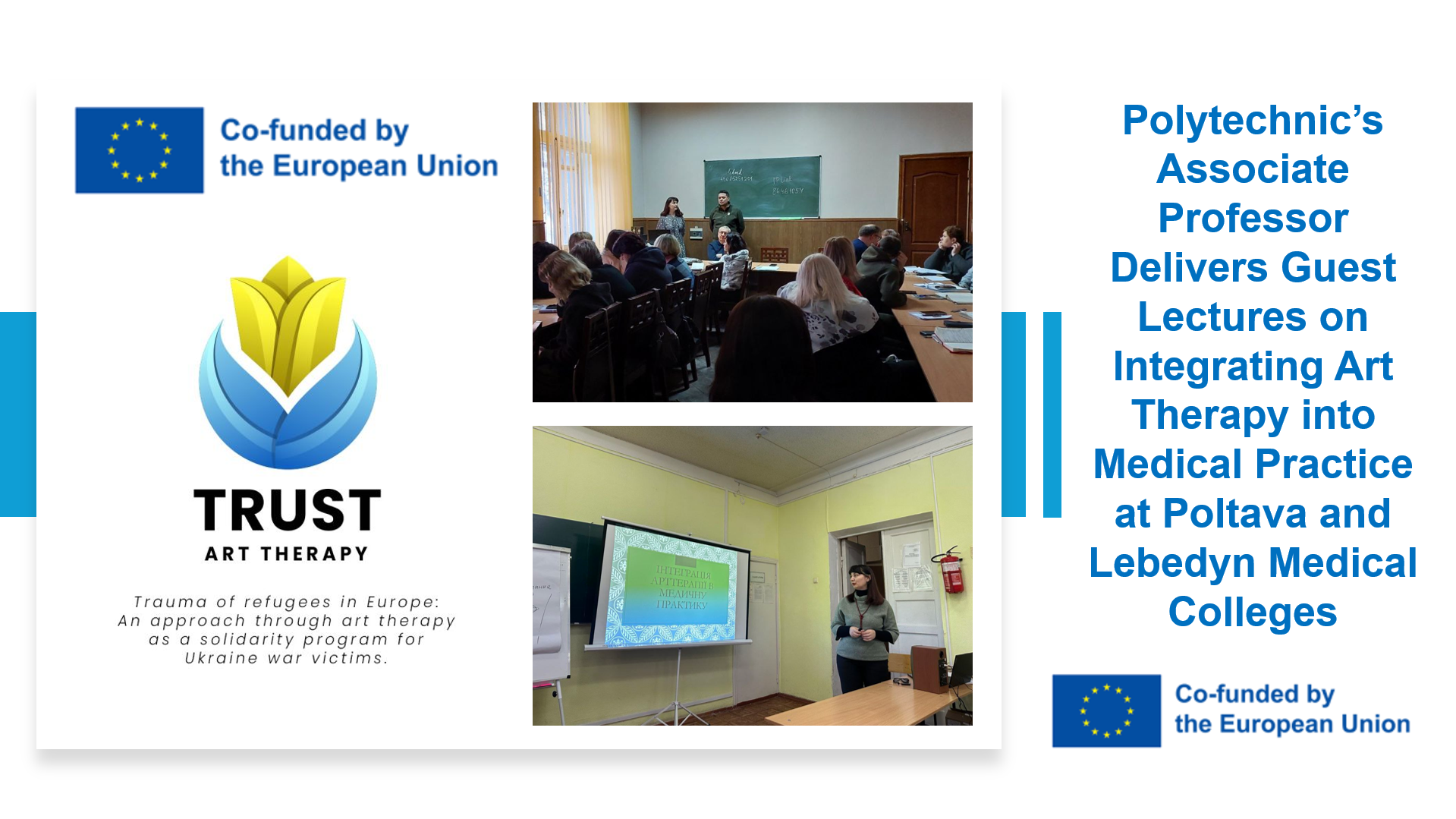
Amidst the ongoing war and the heightened psycho-emotional burden on society, the role of creative and integrative methods of psychosocial support has become critically important. Consequently, integrating art therapy into medical practice is a key priority. Within the framework of the Erasmus+ KA220-ADU project “TRUST”: Trauma of refugees in Europe: An approach through art therapy as a solidarity program for Ukraine war victims (Grant Agreement No. 2024-BE01-KA220-ADU-000257527), aimed at assisting war victims in Ukraine, Poltava Polytechnic’s associate professor has shared her expert experience, demonstrating how these methods can serve as a potent resource for the recovery of both patients and medical staff themselves.
This educational initiative was implemented in January 2026: on January 8th at the Communal Educational Institution “Poltava Basic Professional Medical College of the Poltava Oblast Council”, and on January 12th at the Lebedyn Professional Medical College named after Professor M.I. Sytenko. These guest lectures focused on implementing art therapy in medical practice and were targeted at the teaching staff of the institutions.
The invited speaker for these events was Maryna Teslenko, PhD in Pedagogical Sciences, Associate Professor, and Associate Professor of the Department of Psychology and Pedagogy at the National University “Yuri Kondratyuk Poltava Polytechnic» and “TRUST” project’s steering committee member. She presented a contemporary vision of the role of art therapy in healthcare and the professional training of medical specialists.
During the lecture, the relevance of the topic was thoroughly substantiated, particularly in the context of increasing psycho-emotional strain, experiencing traumatic events, chronic stress, and professional burnout among both patients and medical professionals. In this regard, art therapy was presented as an indispensable and powerful psychosocial resource. It does not compete with traditional methods but organically complements medical treatment, acting as a catalyst for restoring emotional balance, significantly improving patient compliance with prescribed therapy, and fostering a deeper humanisation of medical care overall.
An important and substantial component of the presentation was a detailed look into the historical development of art therapy. The speaker emphasised that the evolution of this field – from being initially perceived as an auxiliary or decorative practice to becoming a recognised, scientifically grounded method of psychotherapeutic and rehabilitation work – mirrors global changes. This evolution reflects a powerful worldwide trend in healthcare: a shift from a purely biomedical model to a holistic, human-centred approach that recognises the inseparable link between a person’s physical, emotional, and creative state.
The audience showed particular interest in practical examples of implementing art therapeutic methods in the rehabilitation departments of Poltava city hospitals and within the framework of ongoing art therapy sessions regularly held at Poltava Polytechnic. During the lecture, the potential of using art therapy (isotherapy) to reduce anxiety levels and process emotional experiences was demonstrated, as well as music therapy as a means of regulating psycho-emotional states and reducing tension. Collage therapy for working with resources, identity, and future self-image; film therapy as a tool for group reflection and processing life experiences; and modelling clay therapy (dough sculpting therapy) as an effective sensorimotor and body-oriented support method were also showcased. The presented cases convincingly demonstrated that art therapeutic techniques are accessible, safe, and flexible for use in medical settings and can be employed in both group and individual work with patients of all ages.
The lectures served not only as an informative session but also as a space for professional dialogue regarding the possibilities of integrating art therapy into the educational process for training future medical professionals. Participants actively engaged in discussions on interdisciplinary collaboration, the ethical considerations of using art therapy methods, and the prospects of incorporating relevant practices and modules into medical college curricula.


The guest lectures confirmed a high level of interest among the teaching staff in implementing modern psychosocial approaches in medical practice. They highlighted the relevance of continued cooperation between specialised secondary education institutions and the university environment. The implementation of art therapy in medicine appears not just as an innovative direction of work but also as an important step toward strengthening humanity, empathy, and a holistic vision of the healing process that centres on the individual, with their unique experience, feelings, and resources.
Maryna Teslenko also dedicated special attention to presenting the international large-scale EU-funded Erasmus+ KA220-ADU project “TRUST” – Trauma of refugees in Europe: An approach through art therapy as a solidarity program for Ukraine war victims (Grant No. 2024-BE01-KA220-ADU-000257527).
The project title is decoded as follows:
TRUST
T – Trauma
R – Refugees
U – Ukraine
S – Solidarity
T – Therapy
The project is co-funded by the EU and led by the Centre Neuro Psychiatrique St-Martin from Belgium, in partnership with the National University “Yuri Kondratyuk Poltava Polytechnic” (Ukraine), Greek Carers Network EPIONI (Greece), Fondazione Don Luigi Di Liegro (Italy), Lekama Developpement (Luxembourg), EuroPlural Project (Portugal).
The lecturer explained that within the “TRUST” project, a series of educational resources is planned for development, including a comprehensive Curriculum and a Hybrid Massive Open Online Course (HMOOC), both dedicated to culturally competent art therapy. These digital resources will enable specialists from various countries to deepen their knowledge on how art can help overcome conflict-related pain, build resilience, and foster social cohesion. Beyond the educational component, the project has a strong socio-cultural dimension, featuring a series of Art Therapy Performances (ATPs) in partner countries and the creation of a documentary film about the participants’ experiences. The culmination will be the creation of a collective art installation in Belgium as a public act of solidarity and recognition of the resilience of the Ukrainian people. Thus, through the “TRUST” project, we are not only creating educational tools but also actively using art as a means of communication, combating stigma, and promoting the European values of peace and inclusivity.