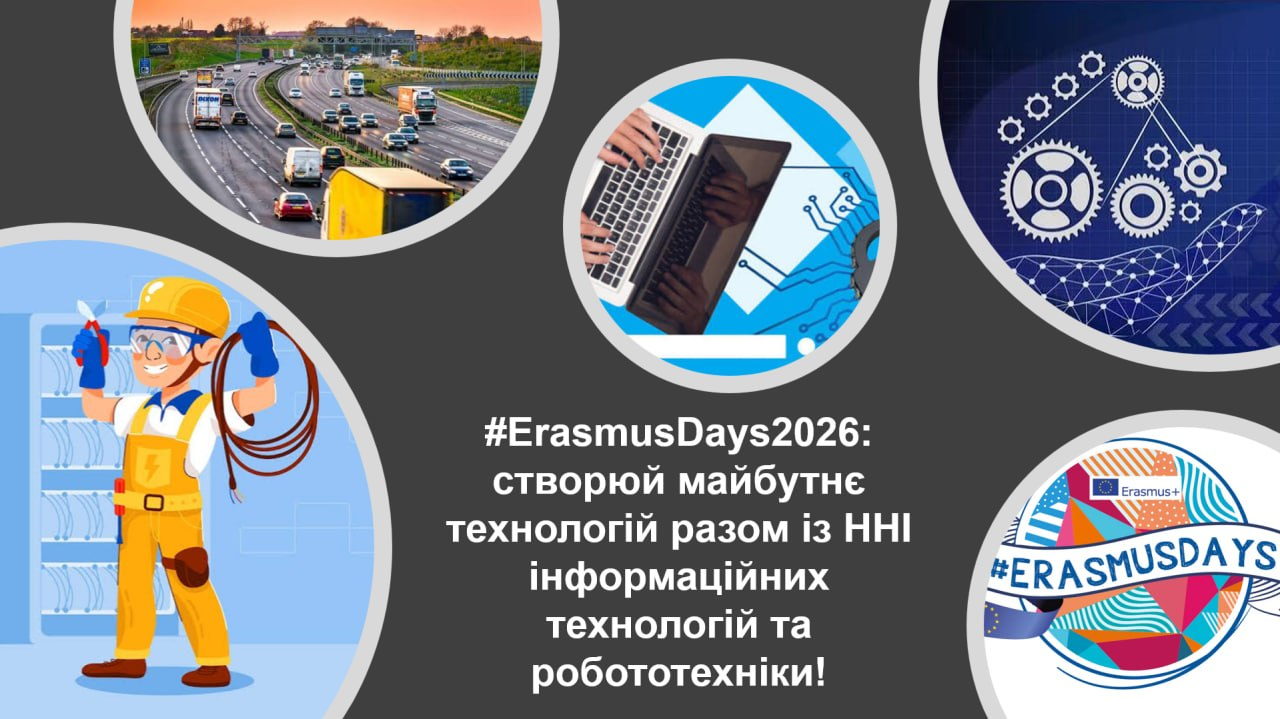
This week, the international tech and academic community celebrates #ErasmusDays2026 – a flagship movement uniting developers, engineers, and researchers worldwide. Poltava Polytechnic continues to expand its global academic partnerships, showing that European academic mobility offers a tangible path for every motivated student and young scientist.
What is #ErasmusDays and why is it essential for future tech innovators?
#ErasmusDays opens the doors to EU educational and grant programs worldwide. In our fast-paced digital world, mastering algorithms solely from textbooks is no longer enough to build an international career.
University years are the perfect launchpad for significant achievements:
- spend a semester in cutting-edge AI and data science labs in Germany or Estonia;
- program industrial robotic arms and automation lines in Poland;
- design sustainable smart grids and electric transport infrastructure in Slovakia or Lithuania;
- explore state-of-the-art cybersecurity testbeds or autonomous vehicle telematics in Austria and the Netherlands.
Funded by the Erasmus+ programme, these experiences are fully accessible opportunities designed to accelerate your growth.
Who will share insights and practical steps?
The event will follow an interactive format:
Anna Pavelieva, PhD in Philology, Associate Professor, and the University's International Relations Coordinator, will break down the entire roadmap: where to track active calls, how to assemble a competitive application package, sign the Learning Agreement, and effortlessly transfer ECTS credits back home.
Students from the Institute, who have completed mobilities abroad, will share firsthand experience on admission challenges, laboratory facilities in Europe, day-to-day life, and how to leverage international certificates into competitive job offers.
Erasmus+ Opportunities across Institute Majors
Opportunities are open to students across all courses (1st–4th year Bachelor, 1st–2nd year Master) and PhD researchers:
- Cybersecurity: training in modern SOC environments, ethical hacking, vulnerability assessments, cloud defence, and EU data privacy directives.
- Computer Science: advanced machine learning, big data architectures, distributed computing, international hackathons, and high-performance computing.
- Computer Engineering: hardware design, FPGA prototyping, IoT sensor networks, embedded firmware development, and cyber-physical setups.
- Robotics and Automated Control Systems: programming industrial robots (KUKA, ABB), Industry 4.0 automation, PLC engineering, and digital twin technology.
- Electromechanical Automation Systems and Electric Drive: digital control of electrical drives, frequency converters, simulation in MATLAB/Simulink, and energy-efficient systems.
- Renewable Energy and Electric Vehicle Power Supply: smart grid design, integration of solar and wind generation, battery energy storage systems (BESS), and EV infrastructure.
- Telecommunications and Radio Engineering: 5G/6G infrastructures, software-defined radio (SDR), satellite comms, and high-speed optical routing.
- Applied Mechanical Engineering: CAD/CAM/CAE systems, industrial additive manufacturing, structural analysis, and automated production.
- Automotive Engineering: electric vehicle powertrains, onboard telematics, advanced driver-assistance systems (ADAS), and connected vehicles.
- PhD Researchers (All years of study): joint experimental work in European R&D centres, access to advanced lab infrastructure, publishing in Scopus / Web of Science (Q1/Q2) journals, and networking within Horizon Europe projects.
Key Program Benefits
100% Grant Funding: tuition-free study abroad plus a substantial monthly grant (€1,150) covering accommodation, travel, and personal expenses.
Transparent Academic Recognition: courses taken abroad transfer to your transcript through the ECTS framework.
Global Career Boost: an Erasmus+ experience sets your CV apart when applying to global tech companies, startups, and R&D divisions.
Agenda Highlights
Partner Universities: which technical universities in Germany, Poland, Austria, Finland, and beyond have slots open for the upcoming semester.
Application Checklist: how to format documents and submit an error-free dossier.
CV & Motivation Letter: tailoring a Europass CV and statement of purpose for technical mobilities.
Language Requirements: practical language thresholds and overcoming confidence hurdles in engineering discussions.
Q&A Session: candid advice from alums on student accommodation, laboratory workflows, and living abroad.
Who is Invited?
We look forward to seeing students from all study years and specialities:
Bachelor’s Degree
- Cybersecurity
- Computer Science
- Computer Engineering
- Applied Mechanical Engineering
- Electromechanical Automation Systems and Electric Drive
- Robotics and Automated Control Systems
- Renewable Energy and Electric Vehicle Power Supply
- Telecommunications and Radio Engineering
- Automotive Engineering
Master’s Degree
- Computer Science
- Computer Engineering
- Applied Mechanical Engineering
- Electromechanical Automation Systems and Electric Drive
- Telecommunication Systems and Networks
- Automotive Engineering
PhD candidates of all study years across technical and IT disciplines!
Event Details
When: October, 14, 2026, at 14:00
Where: room 214-l
Format: in-person open session
Upgrade your skills, discover new horizons, and make your global tech aspirations a reality!
Academic staff at Poltava Polytechnic can participate in academic mobility and training programmes. At the same time, students can pursue credit academic mobility funded by Erasmus+ grants for a semester or an entire academic year at leading universities across Austria, Greenland, Denmark, Estonia, Spain, Lithuania, Latvia, Norway, the Netherlands, Germany, Poland, Portugal, Romania, Slovakia, Finland, and the Czech Republic.