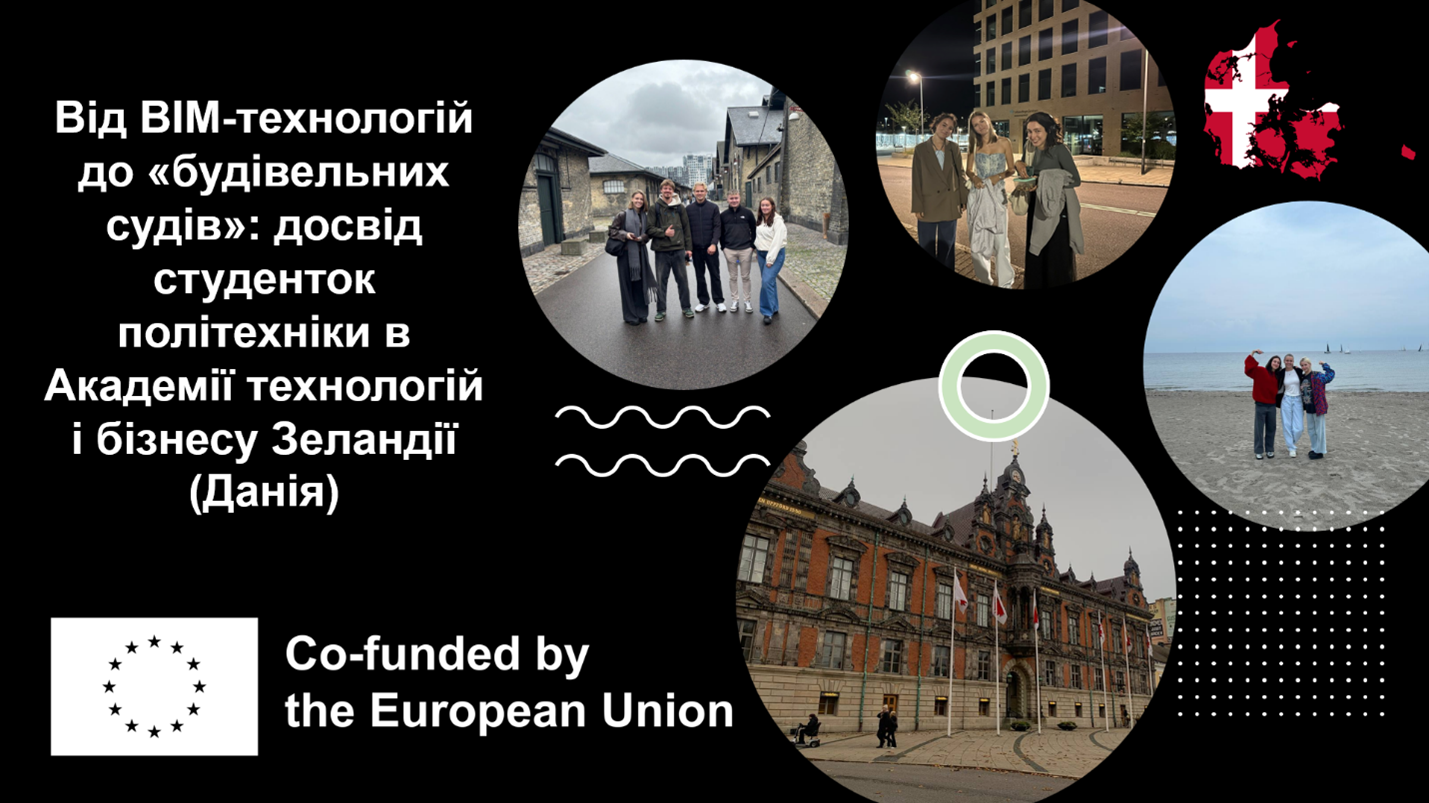
The international study stage has successfully concluded for four higher-education students from the Educational and Scientific Institute of Architecture, Construction, and Land Management at Poltava Polytechnic. Third-year students specialising in 191 “Architecture and Urban Planning” – Yeva Domkina, Maria Parasotska, Ruslana Kravchenko, and Polina Khlystun – completed their first semester of study under the Erasmus+ ICM program at the Zealand Academy of Technologies and Business (ZEALAND, Denmark).
During the autumn semester of the 2025/2026 academic year (from August 19, 2025, to January 31, 2026), the future architects mastered advanced European design and urban planning methodologies, gaining valuable international experience and demonstrating high results, which allowed them to continue their studies under the Erasmus+ credit academic mobility program in Denmark for the second semester. Currently, the students have begun classes in the spring semester, which will last until June 30, 2026, deepening their professional competencies in speciality 191, “Architecture and Urban Planning,” in an international environment.
“The study program at Zealand Academy itself impressed me with its perfect architecture: it is structured extremely clearly, consistently, and logically. What fascinated me most was how harmoniously different disciplines intertwined, creating a holistic picture of the future profession. For example, when we were studying the design of sewage systems in our installation classes, teachers of building structures simultaneously explained the intricacies of laying foundations. Such a synchronous approach allowed us to see the object as a complex whole and to understand how engineering networks and structural elements interact in real life. This significantly facilitated the perception of the material, as each new topic served as a logical continuation of the previous one, leaving no gaps in understanding the construction process.
Physics lessons became a true revelation for me, as they did not resemble the dry rote memorisation of complex formulas at all. We started with the simplest basics – studying the types of impacts on structures and the reactions to them. The teachers used the most accessible examples, such as the principles of operation of ordinary children’s swings, to explain the fundamental laws of mechanics. The most vivid moment was the practical teamwork, when we were given special sets of sticks with holes, hooks, and rubber bands. Our task was to construct a roof model that, under the tension of these very rubber bands, had to maintain its stability, not collapse, and not snap. Such an interactive format helped not just to study the theory, but literally to “feel” physics through touch, understanding how statics work in real architectural forms.
In parallel, management classes gradually immersed us in the professional reality of Denmark. Step by step, we were introduced to the state norms and standards that apply in this country. As it turned out, an incredible number of them exist – a true ocean of regulations in which it is important not just to navigate, but to know where to find a specific answer quickly. This was a real “spoiler” for our future professional activity: an architect in Denmark is not only a creator but also an expert who possesses a flawless command of the regulatory framework. Now, having this experience, I feel much more confident because I understand how European quality and safety standards work in practice, – shares Maria Parasotska.
“The educational process in Denmark is a constant movement, activity, and sincere engagement. Even traditional lectures, which can usually seem monotonous, were perceived completely differently here thanks to our teachers. Jakob, Anders, and Johanna were always so energetic, smiling, and charismatic that they left us no chance to get distracted. They used any method to hold our attention, turning every class into a living dialogue. However, my favourite format was the interactive sessions where theory was instantly transformed into exciting practice.
One of Anders’ experiments stands out, in which we investigated the permeability of materials. We manually poured water into a demonstration container, half of which was filled with ordinary soil and the other with an imitation of a special water drainage cassette. We watched with excitement through which holes in the bottom the water would flow out faster, visually understanding the principles of modern drainage. Such classes often continued in the basement of the academy, where Anders took us to show every building material in reality. There, everything could be touched by hand, the texture could be studied, and any question, even the most complex, could be asked. This gave me a much greater understanding of materials science than simply viewing slides would have.
Another incredible learning tool was the professional “courts” that the teachers regularly enacted with us. Initially, these were individual duels: the class was divided into “client-contractor” pairs, and we had to resolve acute conflict situations. I remember my case well, in which I, as the client, had to confront a builder who demanded additional funds to clean the site of discovered toxic substances. Later, these “courts” grew into team competitions, where one group represented engineers and “computer geniuses”, and the other – “executing builders”. We analysed real errors in projects: for example, when engineers made a mistake in the drawings, and the builders did not notice it and implemented it. It was in such discussions that we learned to take responsibility and seek out the guilty parties, not for the sake of accusations, but for the sake of seeking the truth.
Jakob also adored the “court” format, but he placed the main emphasis on a deep knowledge of standards. He literally “drilled” us on complex Danish norms, specifically SBI255 (building regulations) and AB18 (rules for drafting contracts). His method was flawless: he would tell us a convoluted professional story, and we would race to find in the documents which specific norm this situation fell under and how to regulate it in accordance with the law properly. This was a true competitive drive that taught us to navigate vast amounts of information. Such an experience did not just give me knowledge – it gave me confidence in my own abilities and an understanding of how the world of great architecture works from the inside, – adds Polina Khlystun.
“Our study program in Denmark was built on the principle of a rapid but extremely organic immersion into the profession: from the simplest basics, we quite unnoticeably moved to the complex design of general house plans. This was a real challenge to my attentiveness and precision, as the drawings of foundations or sewage systems required consideration of the smallest nuances – from the diameters and slopes of pipes to the exact calculation of every degree in their turns. We learned to design not just walls, but viable systems: rainwater drainage plans, sidewalk construction, facade development, and site plans. Every line on paper had to be justified, and every engineering node had to be functional.
A special and bright page of my semester was participating in an old building renovation project, which we joined during a short break in the main studies. Working side-by-side with future architects from Ireland and Belgium was incredibly interesting. It was a breath of fresh air and an exchange of unique experiences, after which we returned to academic work with renewed vigour, which quickly transitioned into a phase of meticulous detail. We worked on a large-scale project for a large service station, where each team member had their own sector of responsibility: someone developed the roof, someone developed the trusses or non-load-bearing walls, and my task was to develop load-bearing structures.
This very stage became a true endurance test for me. I confess, honestly, that at certain moments it seemed I would simply go crazy from the volume of tasks and responsibilities. It turned out that design is not only about strength but also about logistics: I needed to plan in detail in which specific fragments the six-meter-high load-bearing walls would be delivered, choose the appropriate transport, and calculate the optimal route. And when complex sections for the installation of windows and doors were added, along with nodes for connecting walls to the foundation, trusses, and roof, every millimetre became worth its weight in gold. It was painstaking intellectual work that required full concentration.
Our evenings turned into real working marathons. The girls and I occupied any free classroom in the university. We sat over the drawings until late at night, until a stern but smiling security guard escorted us out, reminding us that it was time for the building to close. On the last day before submission, as we made the final touches, we were overcome by an incredible, almost childlike sense of happiness. I cannot put into words the relief and pride in the work done when you realise that tomorrow is the final point. It was a difficult path, but it gave me much more than just knowledge – it taught me to work at the limit of my capabilities and to develop a real professional drive, says Yeva Domkina.
“My autumn semester in the Danish city of Næstved flew by in an instant, leaving behind the sweet taste of success and a slight nostalgia for the first months of adaptation. Looking back at my previous impressions, I involuntarily smile: back then, it seemed to me that I had already fully explored this city and knew every cosy corner of it. However, time showed that Denmark knows how to hide its treasures, and with each passing week, I discovered more and more amazing locations that were worth every step and every minute of contemplation. This city became something much more to me than just a point on the mobility map – it became a place of my personal growth.
Since I last spoke about my studies in October, much has changed, and challenges lie ahead whose complexity I could only guess at back then. The approach of the examination period brought a special kind of tension, as the Danish grading system differs significantly from ours. Here, there is only one exam, but it is comprehensive and extremely consequential. Several teachers are present at once, each evaluating your knowledge of their subject through the prism of the project work you have completed. This required not only a deep understanding of theory but also the ability to present the results of one’s work at a high professional level.
A special experience was preparing for the defence as part of an international team. My group consisted of four people: two Danes, a student from the Netherlands, and myself. We worked long and diligently on a joint presentation, which had to last exactly ten minutes. In the Danish academy, timing is not just a suggestion, but a strict requirement that directly affects the final grade. This taught us perfect coordination, conciseness, and the ability to highlight the most important points in the huge volume of information we gathered over the semester.
The exam day itself turned into a real emotional whirlwind. After the team presentation, we left the room, and each of us was invited for an individual interview. Perhaps nothing unites people from different countries like shared panic at a door and a friendly “attack” on the person who just came out of the room, with desperate attempts to find out what the questions were. When the last team member finished their answer, the teachers took a brief break and then invited all of us to join them to announce the results. This feeling of shared victory was incredible: we didn’t just pass the exam; we did it as a single mechanism.
The celebration of success was sincerely student-like and warm. First, the whole group went to McDonald’s, and later, when the teachers were free from official duties, we invited them to a nearby pizzeria as well. Such openness and democracy in communicating with mentors left an extremely pleasant impression. Now, when the first stage of mobility is behind me, I am enveloped in a warm feeling of deep satisfaction. I was able to prove to myself that all efforts were not in vain. Despite a different language, unusual teaching methods, and the challenges of adaptation, I gained invaluable professional experience that once seemed almost unattainable. I am incredibly grateful to Poltava Polytechnic and the Zealand Academy for this opportunity. Although the semester has ended, my story in Denmark continues, because another intensive six-month study stage lies ahead!” – says Ruslana Kravchenko.
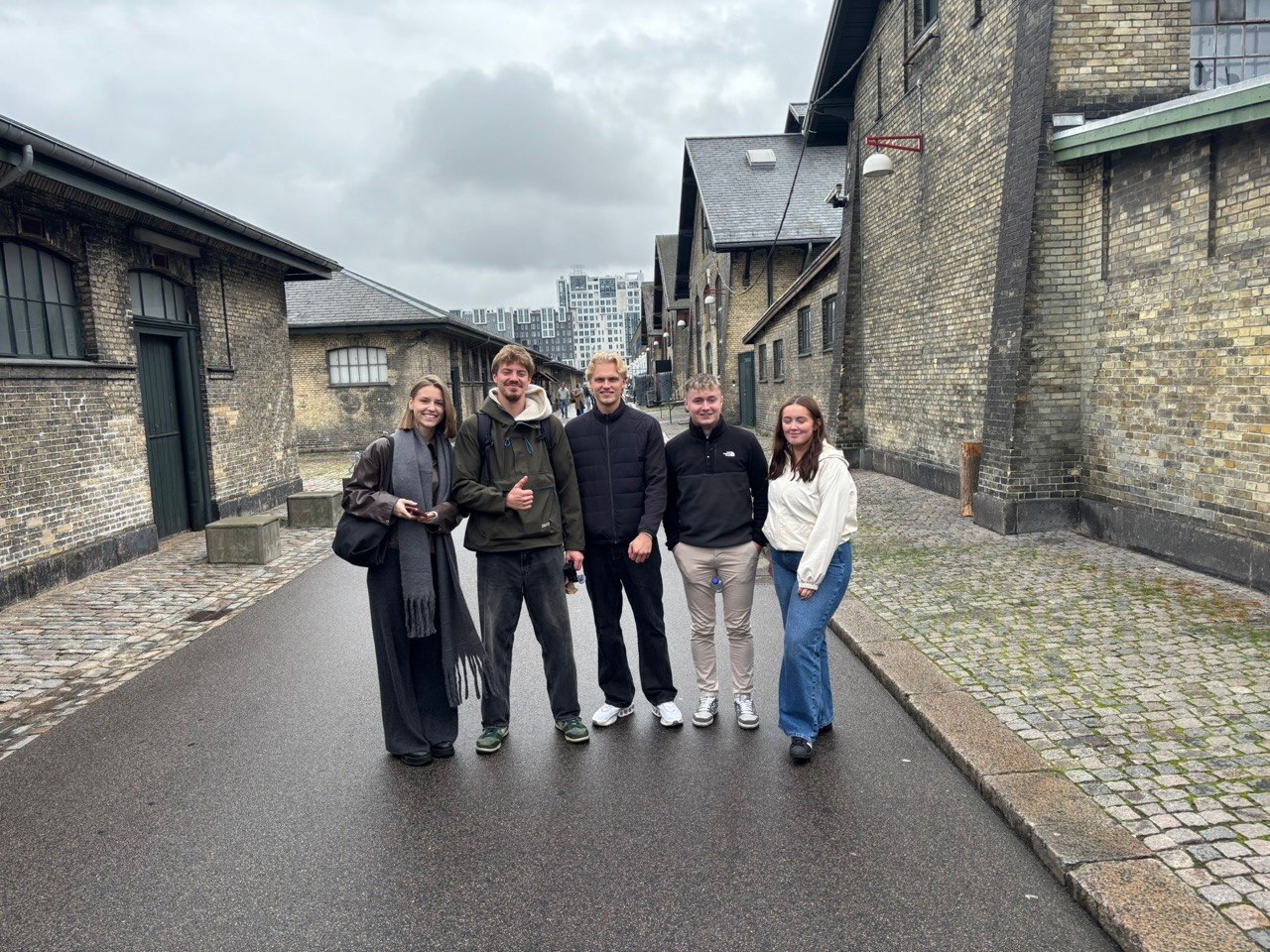
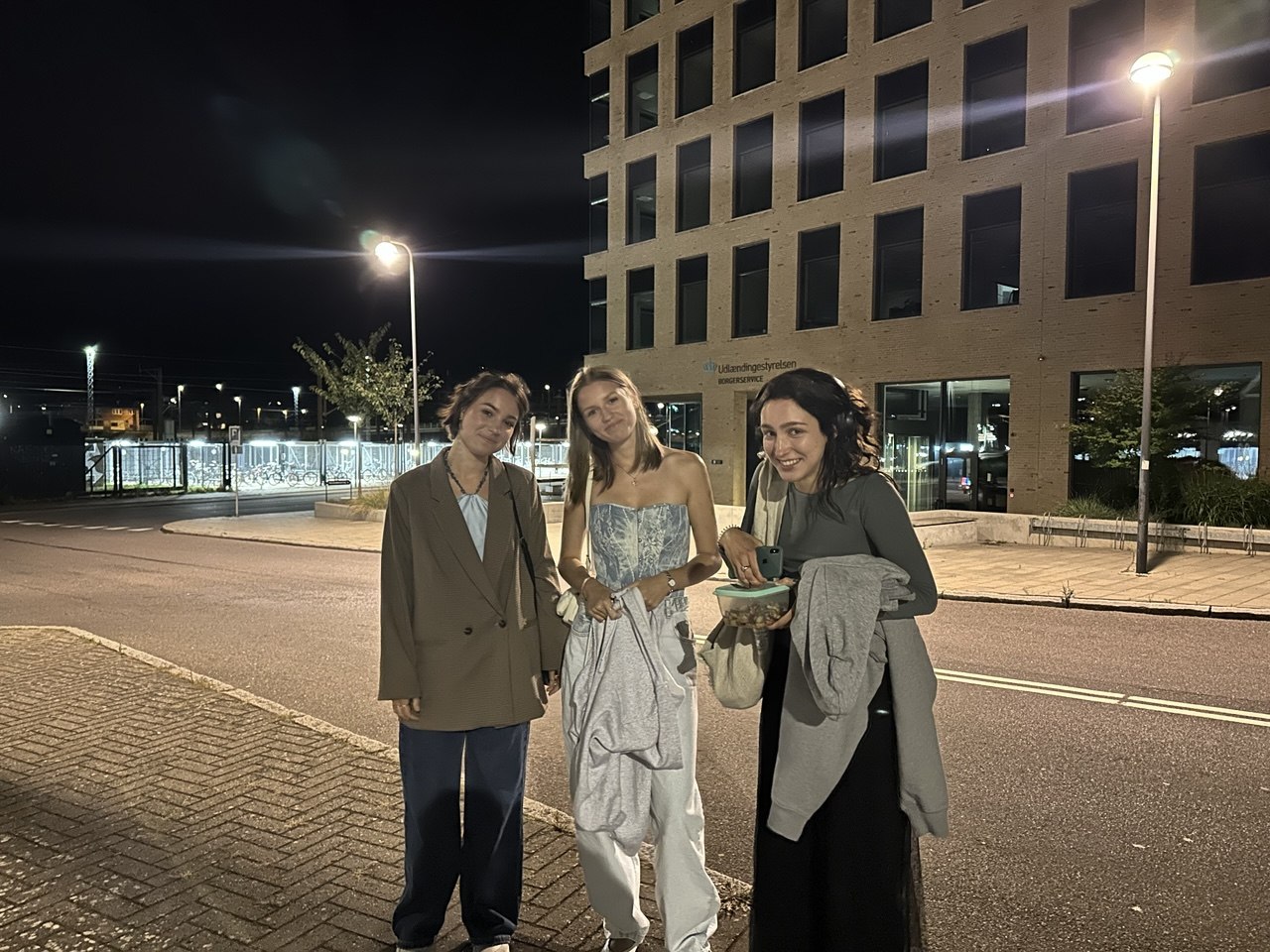
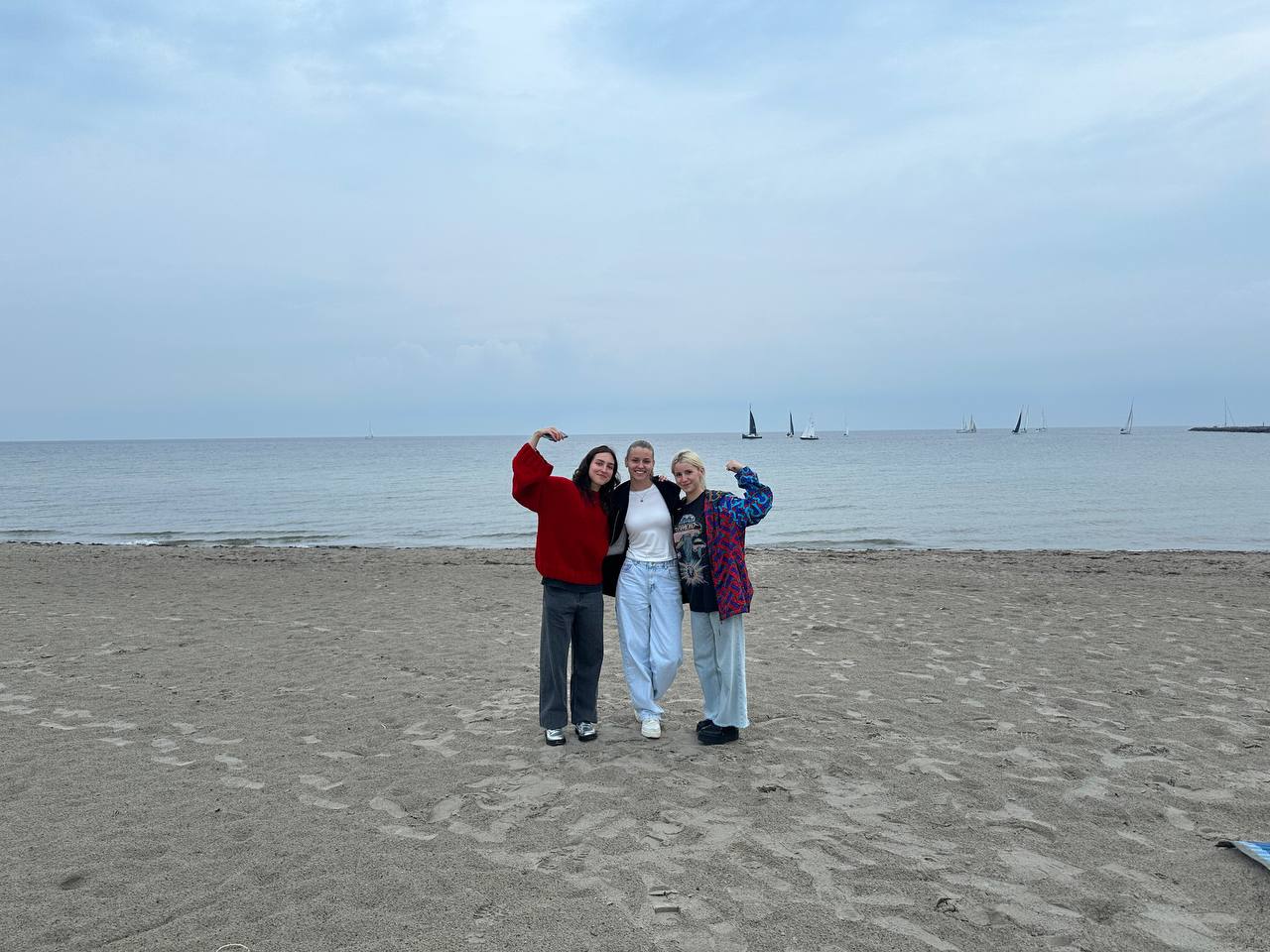
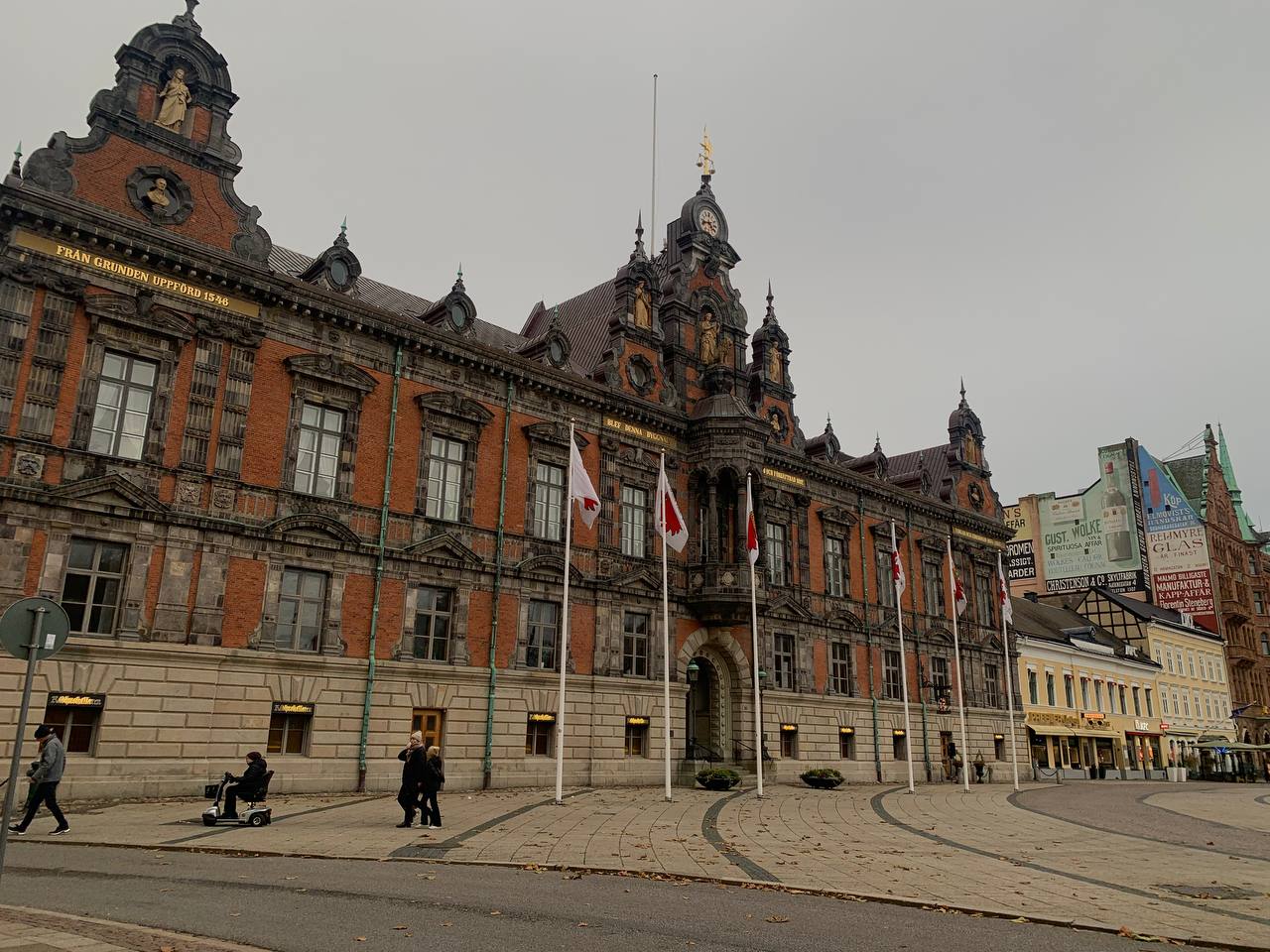
“Our cooperation with Zealand Academy of Technologies and Business has long since transcended the boundaries of official protocols, evolving into a narrative of a true professional family. I wish to express my profound gratitude to Ole Kolling (Director of International Relations and Programmes), Marie-Josée Giasson Jensen, Anders Studsgård Winsløw (International Mobility Ambassadors and Per Mejer (Lawyer and Assistant Professor in Law, Project Management, and Construction) and others for creating a safe and stimulating environment for our students’ growth during these challenging times. Your personal investment in the journey of every student, your patience, and your professional generosity constitute the very foundation upon which international academic mobility rests. Thank you for your tireless energy and for unveiling horizons for our future architects that were once merely a dream. You are true architects of human destinies, and your work represents an invaluable contribution to the future reconstruction of Ukraine!” – says Poltava Polytechnic’s International Relations Coordinator Anna Pavelieva, PhD in Philology, Associate Professor of the Department of Germanic Philology and Translation.
You can read about Maria, Eva, Ruslana and Polina’s first impressions of studying in Denmark in this article.
National University “Yuri Kondratyuk Poltava Polytechnic” has been closely cooperating with ZEALAND Academy of Technologies and Business for 3 years, which cordially hosts Poltava Polytechnic students for studies under the Credit Academic Mobility programs. For example, in the fall of 2023, three Polytechnic students studied there – Iryna Hasan, Mariia Dykan, and Viktoriia Viazovska (you can read about their mobility experience here and here); in the fall of 2024, four students from the Institute of Architecture, Construction, and Land Management studied there (you can read about their impressions of mobility here and here).
As a reminder, faculty members of Poltava Polytechnic are eligible to participate in academic mobility and internship programs. Students can study abroad through Erasmus+ credit academic mobility grant programs for a semester or a full academic year at leading universities in Austria, Greenland, Denmark, Estonia, Finland, Germany, Lithuania, Latvia, Norway, the Netherlands, Poland, Portugal, Romania, Slovakia, Spain, and the Czech Republic.
For more detailed information on current internship, teaching, and academic mobility programs abroad, please get in touch with the International Relations Office (Room 213-C, interoffice@nupp.edu.ua).