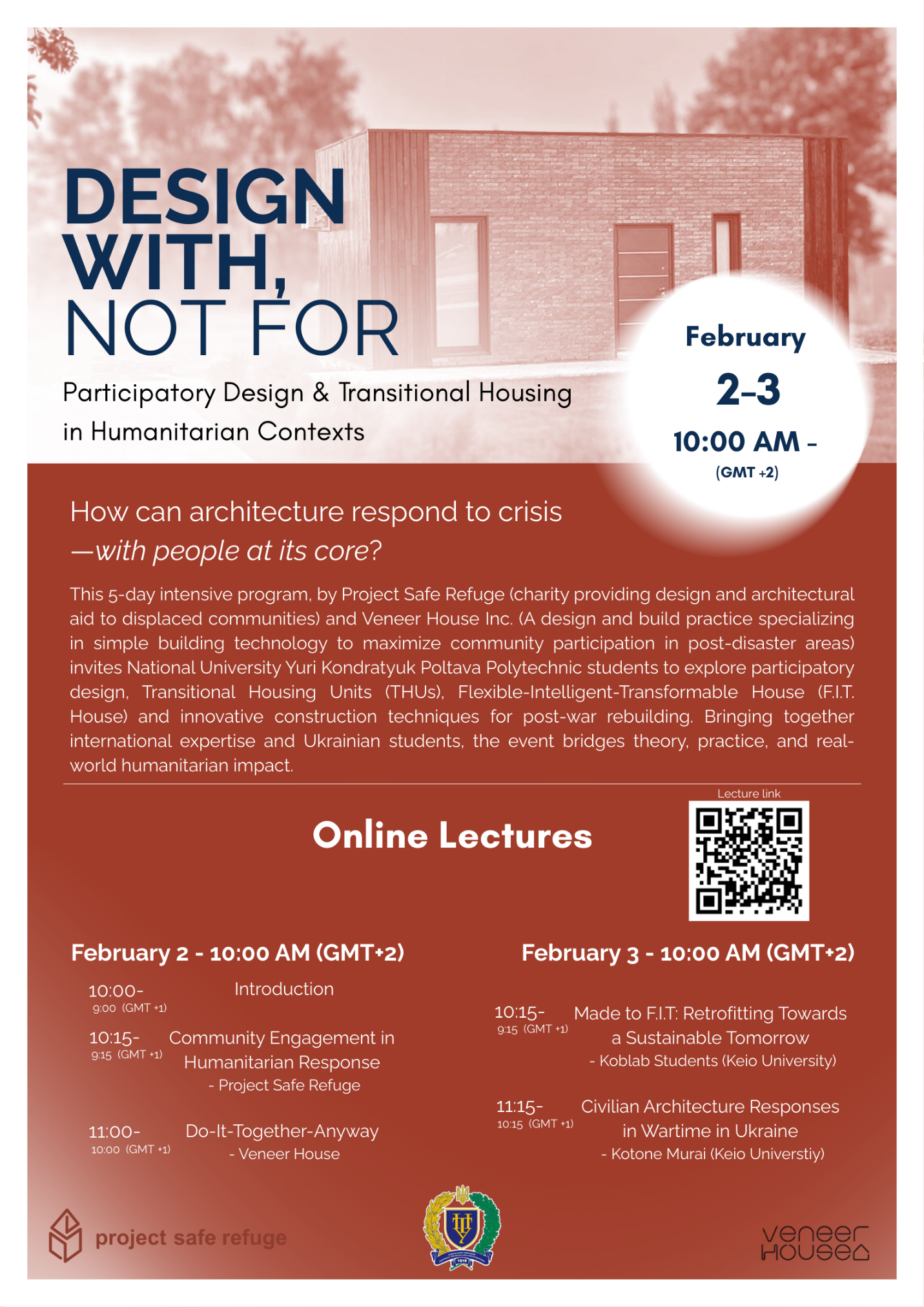
This large-scale event is a joint initiative between the National University “Yuri Kondratyuk Poltava Polytechnic” and leading international partners – Project Safe Refuge Foundation (PSR) (a charity specializing in providing architectural and design aid to displaced persons) and Veneer House Inc. (VH – an architectural practice specializing in participatory design and simple building technologies for post-crisis areas).
The primary goal of the workshop is to engage students from Poltava Polytechnic in exploring and applying innovative reconstruction methodologies, centering the individual and the community in architectural solutions. The project aligns with PSR’s mission for knowledge exchange and public engagement in the design process, fostering dialogue about reconstruction using new, sustainable methods.
The workshop includes a series of open lectures and practical workshops where students will study concepts of participatory design, the planning of Transitional Housing Units (THUs), and innovative building technologies, such as the Flexible-Intelligent-Transformable House (F.I.T. House), developed by researchers at Keio University.
Project Aim and Objectives
Aim: to introduce students to participatory design principles in humanitarian contexts and innovative construction techniques to facilitate post-war reconstruction, focusing on community-centered solutions.
Objectives
1. Introduce new foreign building technology to help in post-war rebuilding.
2. Determine the opportunities and constraints of adapting new building technology to the Ukrainian building industry and environment.
3. Share ideas on how to communicate building design and construction effectively for people not familiar with the building industry.
4. Facilitate collaboration between university students in Ukraine with Project Safe Refuge and Veneer House Inc. in the design and construction of a post-war housing prototype.
Learning Outcomes
By the end of the workshop, participants will:
1. Understand the key architectural design aspects for post-disaster rebuilding.
2. Understand the design and construction sequence of the Fithouse Poland Prototype.
3. Understand how to communicate the architecture design and construction process effectively to people not familiar with the building industry.
4. Understand the challenges in adapting foreign building technology to the Ukrainian context (in terms of materials, labor, environment, etc.).
5. Understand how buildings can perform (or be used) before, during, and after disasters, and gain insight into current issues in emergency shelters, transitional housing towards permanent housing, and ongoing research in this field.
6. Understand the role of Participatory Design in Humanitarian Projects.
Workshop Logistics (Hybrid Format)
The workshop is structured as a hybrid event, adapted to modern conditions and challenges in Ukraine:
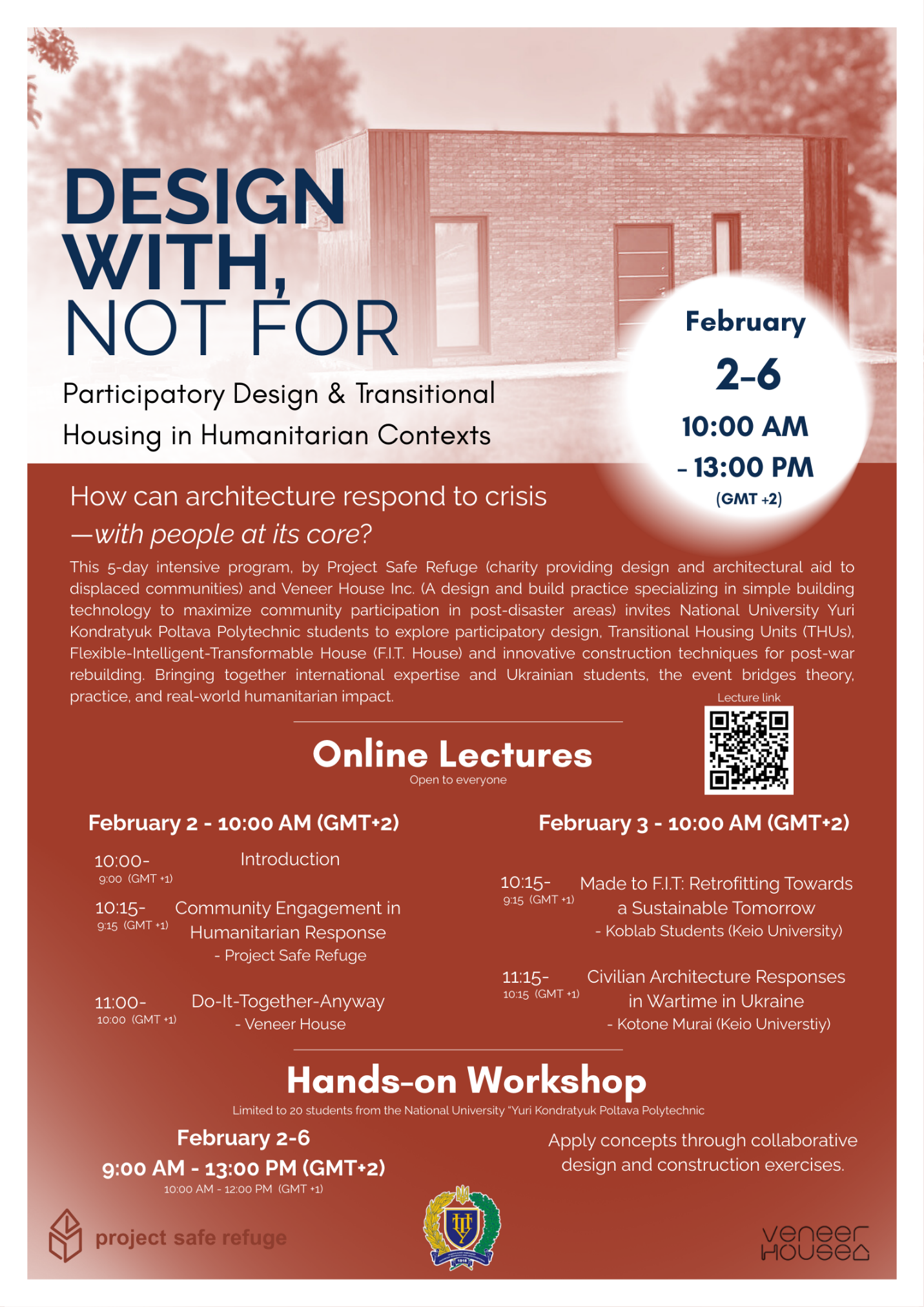
1. Online Lectures (Open to Everyone)
The lecture portion is open to all interested parties (students, faculty, and the public). All instructors will join online. The lectures will be held via Zoom (or Google Meets).
Dates & Time: February 2–6, 10:00 AM – 1:00 PM (GMT+2 / EET)
Due to potential logistical challenges related to power supply and internet access, the university plans to provide a lecture hall equipped with a projector and screen where participants can gather to collectively attend the online sessions.*
2. Hands-on Workshop (Limited Enrollment)
Practical sessions are designed for intensive, hands-on work.
Participants: limited to 20 students from the Architecture and Civil Engineering departments (Master’s level students preferred).
Dates & Time: February 2–6, 9:00 AM – 1:00 PM (GMT+2 / EET)
Participants will be divided into four groups of five to conduct an in-depth critical analysis of the PSR pilot project (THU) in Trostianets, focusing on topics such as spatial design, climate adaptation, compliance with Ukrainian building codes, logistics, assembly/disassembly, and sustainability.
Day-by-Day Agenda
The five-day program transitions participants from theoretical foundational concepts to practical prototyping and design proposals.
|
Day |
Date |
Activity Type |
Topic / Description |
Instructors |
|
Day 1 |
Monday, February 2, 2026 |
Lecture 1 |
Workshop introduction (Aims, structure, methodology) |
Veneer House & Project Safe Refuge |
|
Lecture 2 |
Community Engagement and Participatory Design in Humanitarian Response (Case study of PSR’s THU in Trostianets and Polish participatory workshops). |
Project Safe Refuge |
||
|
Day 2 |
Tuesday, February 3, 2026 |
Lecture |
Participatory Design in Humanitarian Architecture for Post-disaster Rebuilding (Key aspects of post-disaster reconstruction, Fithouse Inc. presentation, Fithouse Poland Prototype, Fithouse Koblab research). |
Veneer House Inc. |
|
Day 3 |
Wednesday, February 4, 2026 |
Practical Session 1 |
Case study critical analysis THU pilot (In-depth analysis of PSR's existing shelter project in Trostianets, focusing on technical requirements and community suitability). |
Veneer House & Project Safe Refuge |
|
Practical Session 2 |
Assessment of the Fithouse Poland prototype (Discussion on adaptability, flexibility, and relocation feasibility). |
Veneer House & Project Safe Refuge
|
||
|
Day 4 |
Thursday, February 5, 2026 |
Lecture |
Experiments and development story of F.I.T. House |
Keio University Koblab Students |
|
Practical Session |
Design and relocation Fithouse Poland prototype (Group development of new Fithouse prototypes adapted for Ukrainian permanent/temporary application). |
Veneer House & Project Safe Refuge |
||
|
Day 5 |
Friday, February 6, 2026 |
Practical Session |
Presentation of new prototype design and implementation plan (Presentation of design proposals, implementation plans, and building manuals intended for non-professional users. Expert critique and Q&A). |
Veneer House & Project Safe Refuge |
Technical Requirements and Registration
Required Materials (for Practical Workshop)
Participants are expected to utilize digital tools (e.g., Rhino, Revit) for practical sessions. Materials for physical modeling (cardboard, foam, MDF) at a scale of 1:10 or 1:30/1:50 will also be required for rapid design studies and final presentations. Due to infrastructure challenges, organizers prioritize digital material submission, and feedback sessions will be adapted to maximize student availability.
We are sincerely grateful to our partners for their understanding of the extremely challenging conditions faced by our students and their readiness to flexibly adapt the workshop plan.
Students in construction and architecture, as well as all interested parties wishing to join the limited practical workshop group (20 participants), must promptly submit their data (Full Name, contact information, specialty, and year of study) to the International Relations Office of Poltava Polytechnic (Room 213-C, interoffice@pntu.edu.ua).
We are confident that this workshop will be a vital step in preparing future specialists for the reconstruction of our country!
Poltava Polytechnic continues to confidently expand the boundaries of opportunity, proving that for ambitious youth, the European educational space is open today.
As a reminder, faculty members of Poltava Polytechnic are eligible to participate in academic mobility and internship programs. Students can study abroad through Erasmus+ credit academic mobility grant programs for a semester or a full academic year at leading universities in Austria, Greenland, Denmark, Estonia, Finland, France, Germany, Greece, Ireland, Italy, Latvia, Lithuania, Luxembourg, the Netherlands, Norway, Poland, Portugal, Romania, Slovakia, Spain, Sweden, and the Czech Republic.
For more detailed information on current internship, teaching, and academic mobility programs abroad, please get in touch with the International Relations Office (office 213-C, interoffice@nupp.edu.ua) or the coordinator of international activities at the National University “Yuri Kondratyuk Poltava Polytechnic” – Anna Pavelieva, Ph.D. in Philology, Associate Professor of the Department of Germanic Philology and Translation (email: kunsite.zi@gmail.com, phone: +38-(095)-91-08-192).