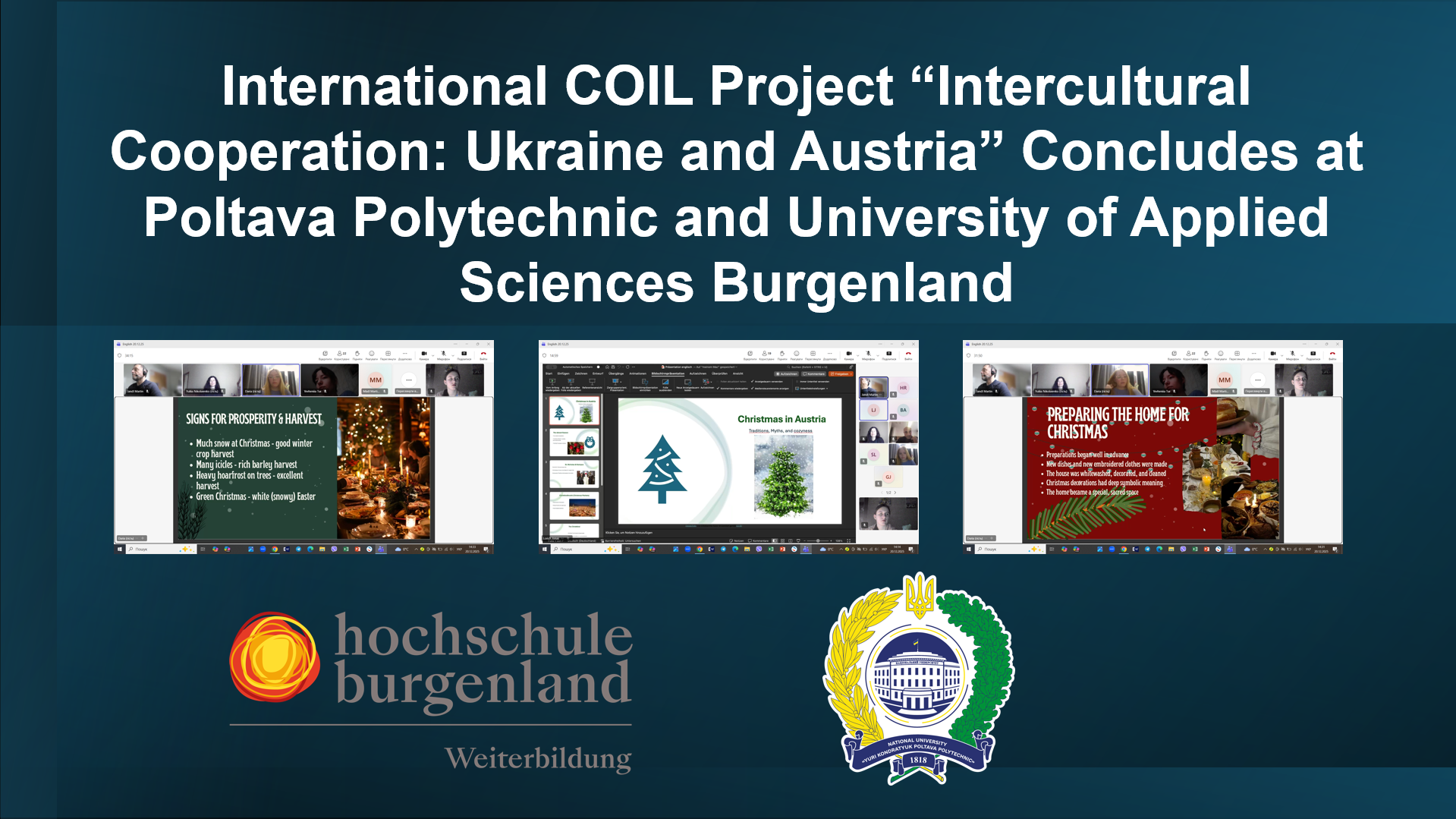
The final stage of the international COIL project “Intercultural Cooperation: Ukraine and Austria”, implemented in partnership with the Austrian University of Applied Sciences Burgenland (Hochschule Burgenland), took place in December 2025. This project united participants from both countries and provided a venue for lively intercultural dialogue, exchange of experiences, and collaborative creative work.
The project was moderated by Yuliia Nikolaenko, Associate Professor of the Department of Germanic Philology and Translation at Poltava Polytechnic, and Martin Jandl, Master of Philology and English Language Lecturer at the University of Applied Sciences Burgenland (Hochschule Burgenland).
The final online sessions for students from both higher education institutions focused on Christmas and New Year traditions in Austria and Ukraine. Students had the opportunity to present their countries’ festive traditions, discuss the specifics of celebrating Christmas and New Year, and share traditional dishes, symbols, customs, carols, gifts, and more.
Participants from Austria discovered the traditions of Ukrainian Christmas (Vertep, Didukh, twelve traditional Christmas dishes), learned about the creation of “Shchedryk” (Carol of the Bells), which conquered the world, and the role this melody played in the fight for Ukraine’s independence. They also listened to this legendary “shchedrivka” performed by the band “Homin” within the Austrian Parliament in Vienna. Ukrainian students learned about Krampus and Christkindl, where the best Christmas markets are held, and what is typically prepared for Christmas in Austria, including roast goose, carp, potato salad, and Weinachtskekse (Christmas cookies). Live communication and interactive presentations helped to understand better the cultural context and the significance of these holidays in the daily lives of Ukrainians and Austrians.
An important part of the meeting was teamwork in international groups. Participants compared the similarities and differences in their holiday celebrations, discussed the role of traditions in preserving cultural identity, and designed joint creative online materials. This format fostered the development of teamwork, critical thinking, and effective communication skills in an international environment. The atmosphere of the sessions was warm, festive, and highly inspiring, and the exchange of traditions provided participants with new ideas and vivid impressions.
The COIL format allowed participants not only to deepen their knowledge of another country’s culture but also to experience, in practice, the value of cooperation, openness, and mutual respect. The joint online sessions demonstrated how modern digital tools can unite people, overcoming geographical borders. Such initiatives contribute to the formation of a global mindset, the development of intercultural competence, the recognition of common European values, and readiness for intercultural dialogue.
.png)
.png)
.png)
.png)
.png)
.png)
.png)
This project, filled with the Christmas spirit, became not just an academic exchange but a true bridge of understanding that will long warm the hearts of the participants. We believe that the traditions we shared will become an inextinguishable flame in the hearts of the students, and this friendship, born in the virtual space, will continue in new joint achievements. Until our next meetings, full of discoveries!
National University “Yuri Kondratyuk Poltava Polytechnic” thanks its partners at the University of Applied Sciences Burgenland for their fruitful cooperation and assistance in implementing this important project!
It is worth noting that in the autumn of 2025, Yuliia Nikolaenko participated in the Erasmus+ academic mobility program for the third time at the Austrian University of Applied Sciences Burgenland (Hochschule Burgenland); previously, she had participated in the Erasmus+ and CEEPUS staff mobility programs at the same institution.
We remind you that lecturers from Poltava Polytechnic can participate in academic mobility and traineeship programs. Students can study abroad through Erasmus+ credit academic mobility grant programs for a semester or a full academic year at leading universities in Austria, Greenland, Denmark, Estonia, Spain, Lithuania, Latvia, Norway, the Netherlands, Germany, Poland, Portugal, Romania, Slovakia, Finland, and the Czech Republic.
For more detailed information on current traineeships, teaching, and academic mobility programs abroad, please get in touch with the International Relations Department (Room 213-C, interoffice@nupp.edu.ua).