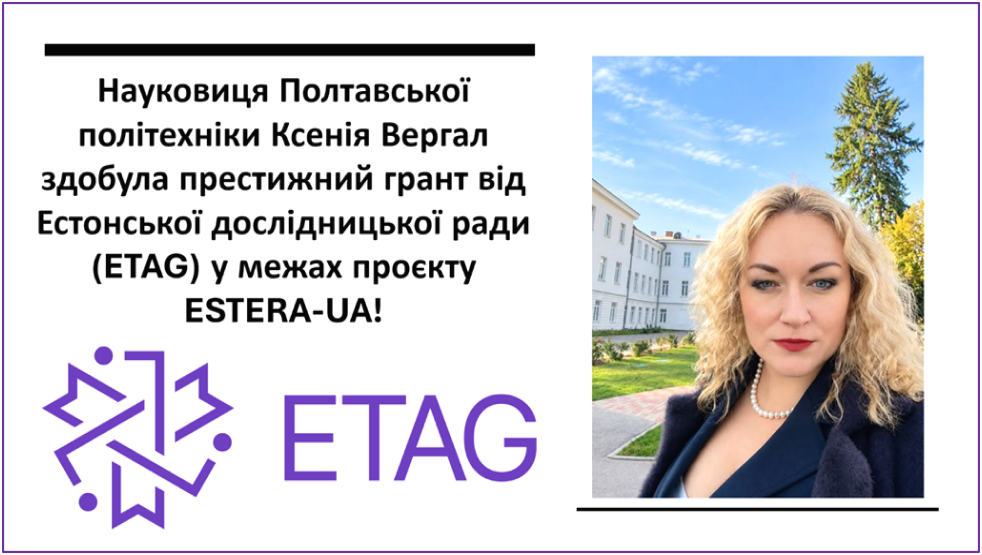
National University “Yuri Kondratyuk Poltava Polytechnic” continues to strengthen its standing as one of Ukraine's leading innovation and research centres, with intellectual potential recognised at the highest international level. With systematic support for academic mobility and the advancement of cutting-edge research, university scholars are actively integrating into the global scientific community and establishing reliable partnerships with leading European academic institutions. Another clear testament to Poltava Polytechnic’s strong international standing is the success of Kseniia Verhal, Deputy Director of the Educational and Research Institute of Information Technologies and Robotics, who secured funding through a prestigious grant programme supporting Ukrainian researchers.
The funding is provided under the dedicated initiative “Travel and Collaboration Grants Supporting Ukraine’s Integration into the European Research Area”, coordinated by the Estonian Research Council (ETAG) in close cooperation with the Estonian Centre for International Development (ESTDEV) and supported by the ESTERA-UA project. This grant programme aims to facilitate the practical integration of the Ukrainian academic community into the European Research Area (ERA), provide targeted opportunities for direct scientific collaboration, mitigate the consequences of crisis challenges, and build long-term partnerships with Estonian research institutions. The decision to award the grant to the Poltava researcher was officially approved by the Board of the Estonian Research Council, confirming the strategic relevance and high expert assessment of her proposed research programme.
The host institution is Tallinn University, one of the most progressive educational and innovation hubs in Northern Europe. Estonia is widely recognized as a global leader in digital transformation and the integration of cutting-edge information systems into public life and education, while Tallinn University itself is renowned for its advanced expertise in digital technologies and human-computer interaction. The direct venue for implementing the research programme will be the university's School of Digital Technologies, headed by Director Tiit Vapper, where, under the coordination of Head of Research Administration Kadri Mettis, the Poltava Polytechnic representative will conduct research as a visiting scholar.
The programme of the two-week stay in Estonia is distinguished by its intensive, structured, and applied character. It will begin with an extensive institutional exchange, during which Kseniia Verhal will hold a series of working meetings with leading experts, academic departments, and laboratories of Tallinn University to assess shared competencies, explore modern research infrastructure, and present the achievements of Poltava Polytechnic. The next stage will feature a series of thematic seminars and roundtables designed to combine Ukrainian and Estonian expertise in collaboratively developing key research directions at the intersection of artificial intelligence, digitalization, and the development of higher education.
The core substance of the research and training programme centers on four key interdisciplinary pillars, each addressing contemporary global technological challenges. The first direction focuses on AI-mediated communication: examining the impact of large language models and generative AI on academic writing, issues of preserving students' individual authorial voice and identity, and advancing natural language processing technologies for low-resource languages, with a particular focus on the Ukrainian language. The second pillar encompasses the human-centered dimension of artificial intelligence in higher education, addressing psychological barriers, trust levels, academic integrity challenges, and the development of ethical standards for utilizing emerging tools within the university environment.
Equally significant are the third and fourth pillars of the programme, which focus on the impact of digital technologies on the transformation of professions, the updating of university curricula to meet dynamic labor market demands, and the development of so-called “resilient education”. The latter aspect holds exceptional practical significance for Ukraine, as it involves utilizing intelligent systems to design personalized adaptive learning trajectories, ensure digital inclusion, foster psycho-emotional well-being, and maintain educational continuity under challenging crisis and wartime conditions.
The culminating outcome of the visit will be the joint development of a comprehensive Concept Note for a project proposal to be submitted under Horizon Europe, the European Union's flagship framework programme for research and innovation. Together with her Estonian colleagues, the researcher will detail the methodology of the upcoming study, establish work packages, coordinate a monitoring plan for the expected societal impact, and define the architecture of a future international scientific consortium, engaging leading universities, research institutions, and digital business representatives from other European countries. Furthermore, the visit's agenda includes planning joint publications in prestigious international journals indexed in the Scopus and Web of Science databases, as well as laying the groundwork for further bilateral academic mobility of researchers and students.
This achievement not only attests to Kseniia Verhal's substantial personal contribution to modern engineering and computer science, but also lays a solid foundation for possible partnership between Poltava Polytechnic and Tallinn University. The experience, new tools, and innovative methodologies developed during the visit will be integrated into the educational process of the Educational and Research Institute of Information Technologies and Robotics, contributing to the modernization of courses and opening new prospects for university students and early-career researchers.
The community of Poltava Polytechnic is proud of their colleague's success, sincerely congratulates her on this significant grant milestone, and wishes her utmost productivity in implementing all planned research activities on the European stage.
Recently, grant funding from the Estonian Research Council (ETAG) under the ESTERA-UA project was also awarded to Alina Zyhun, PhD in Technical Sciences, Associate Professor at the Department of Building and Civil Engineering of the Educational and Research Institute of Architecture, Construction, and Land Management. Her research project focuses on sustainable urban mobility and involves a scientific fellowship at the Estonian University of Life Sciences (Tartu) to examine advanced European practices in bicycle infrastructure development and integrate them into Poltava’s post-war reconstruction.
It is worth recalling that academic staff of Poltava Polytechnic can participate in Erasmus+ Staff Mobility programmes for internships, professional development, and teaching, while higher education students can study under grant scholarship programmes for credit academic mobility for a semester or an academic year at leading universities across Austria, Greenland, Denmark, Estonia, Spain, Canada, Lithuania, Latvia, Norway, the Netherlands, Germany, Poland, Portugal, Romania, Slovakia, the United States, Finland, France, and the Czech Republic.