National University “Yuri Kondratyuk Poltava Polytechnic” continues to steadily consolidate its position within the European academic and research area, demonstrating the high competitiveness of Ukrainian researchers on the international stage.
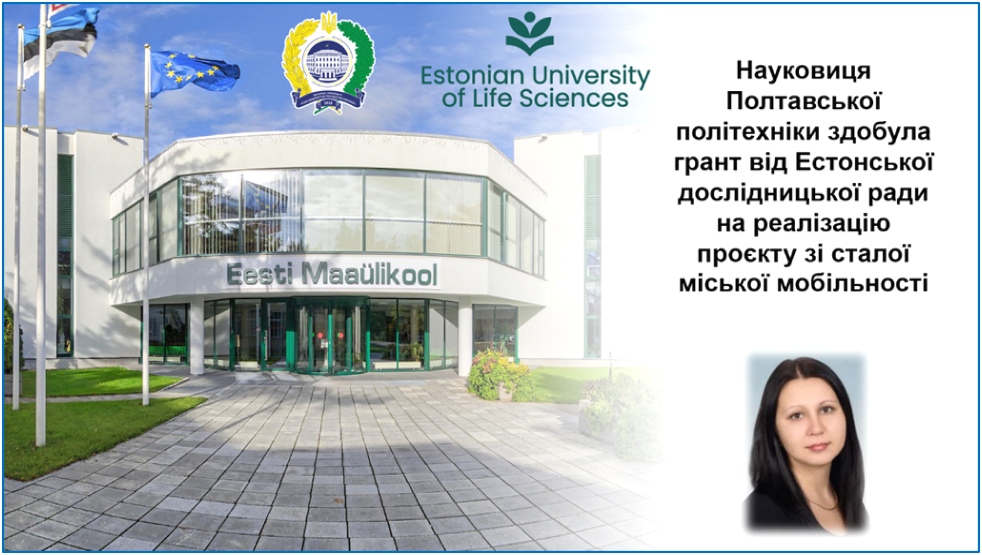
Another significant testament to this recognition is the success of Alina Zyhun, PhD in Technical Sciences in Urban Planning and Spatial Planning, Associate Professor at the Department of Building and Civil Engineering of the Educational and Research Institute of Architecture, Construction, and Land Management, in the prestigious competition “Travel and Collaboration Grants Supporting Ukraine’s Integration into the European Research Area” within the large-scale ESTERA-UA project. The Chairman of the Board of the Estonian Research Council (Eesti Teadusagentuur – ETAG) officially adopted and approved the decision to fund the researcher's scientific initiative, with support from the Estonian Centre for International Development (ESTDEV).
This authoritative international programme is designed to comprehensively facilitate the accelerated integration of Ukrainian higher education and research institutions into the European Research Area (ERA) by fostering an environment conducive to direct dialogue between leading scholars, establishing new partnerships, and elaborating joint applications for funding under the EU Framework Programme for Research and Innovation “Horizon Europe”. The approval of the Poltava researcher’s grant application was the logical result of her many years of work in urban studies and transport planning, as well as fruitful institutional cooperation with the university’s International Relations Office.
Under the allocated grant funding, from 9 to 20 November 2026, Associate Professor Alina Zyhun will conduct a two-week research visit to one of the Baltic region's leading agricultural, natural, and environmental centres – the Estonian University of Life Sciences (Eesti Maaülikool), located in the historic university town of Tartu. The international fellowship and collaborative research will take place at the Department of Landscape Architecture, supported by Ms Karoli Kõiv, Head of the International Relations Department at the Estonian university. This academic setting is both deeply symbolic and strategically reasoned, as Tartu is widely regarded as one of Northern Europe’s most successful models for harmoniously implementing “green” policies, sustainable mobility, and human-centred urban design.
“Internationalisation of scientific research is not merely a strategic priority for Poltava Polytechnic, but an ongoing, comprehensive endeavour that opens a direct pathway for our scholars to European research networks. Such substantial achievements are primarily made possible thanks to the undeniable leadership, forward-looking vision, and multifaceted support of our university leadership. We express our special gratitude to President Volodymyr Onyshchenko and Rector Olena Filonych, who consistently keep the international vector at the forefront of priority attention, cultivate a uniquely open ecosystem for academic diplomacy, and actively encourage the submission of ambitious international grant proposals. Thanks to this strong institutional support, our International Relations Office and Polytechnic researchers feel confident in their capabilities and have the resources to reach the highest peaks.
Alina Zyhun's success in the ESTERA-UA call is a vivid example of how advanced professional expertise and the university's strategic course translate into recognition by leading European funding bodies. Today, Estonia is a recognised leader in sustainable development, and our long-standing partner – the Estonian University of Life Sciences – is a flagship in spatial planning. We are convinced that this visit will lay a solid foundation not only for the successful implementation of this relevant urban planning project, but also for the further expansion of partnership between our higher education institutions. We sincerely congratulate our colleague and confidently move forward towards new international horizons!” – stated Anna Pavelieva, International Relations Coordinator of Poltava Polytechnic.
The central topic of the Poltava researcher’s scientific project is “Development of Bicycle Infrastructure in Recreational and Residential Areas: Tartu Experience and Implementation in Poltava”. The study focuses on an in-depth analysis of advanced Estonian practices in integrating extensive cycling networks, establishing multifunctional micromobility hubs, and developing continuous green transport corridors. The researcher's agenda in Estonia includes conducting a series of urban field observations and measurements within Tartu's urban fabric, examining engineering solutions for segregating vehicular and pedestrian flows, and engaging in an extensive exchange of spatial planning methodologies with leading Baltic experts.
The project's practical value lies in the synergy of professional competencies between both parties, as the rich experience of Estonian colleagues in spatial planning and landscape architecture will complement the robust civil engineering capacity of Poltava Polytechnic. The spatial models and design solutions developed during the fellowship will serve as a scientific foundation for creating a comfortable bicycle network in recreational areas and residential neighbourhoods of Poltava. Furthermore, the resulting recommendations may contribute significantly to developing effective engineering concepts for the comprehensive post-war reconstruction and modernisation of transport infrastructure across Ukrainian communities, in line with modern European standards of accessibility, environmental sustainability, and climate resilience.
Beyond addressing purely applied urban planning tasks, the visit holds distinct strategic significance for deepening institutional research cooperation between the higher education institutions. Based on the outcomes of their joint work, the researcher plans to prepare a manuscript for a comparative scholarly study on micromobility for publication in prestigious international peer-reviewed journals indexed in Scopus and Web of Science. Additionally, a working group comprising Ukrainian and Estonian scholars will elaborate a detailed step-by-step plan and concept for submitting joint project proposals to upcoming Horizon Europe grant calls, particularly within the thematic areas of Cluster 5 (Climate, Energy and Mobility), Cluster 6 regarding biodiversity and sustainable urban ecosystems, as well as under the ambitious EU Mission on Climate-Neutral and Smart Cities.
In parallel, meetings with the leadership and academic community of the Estonian University of Life Sciences are planned to develop a roadmap for substantially expanding cooperation within the Erasmus+ programme, which in the near term will unlock unique new opportunities for semester-long and short-term academic mobility for undergraduate and postgraduate students, and academic staff in engineering and urban planning disciplines at Poltava Polytechnic.
“Securing this prestigious European grant is not only my personal achievement, but above all a significant joint accomplishment of our university team and Poltava Polytechnic's consistent course towards comprehensive internationalisation”, Alina Zyhun noted – “I express my most sincere and profound gratitude to the University President Volodymyr Onyshchenko for his strategic leadership, forward-thinking vision, and the development of a modern research ecosystem in which our alma mater's scholars have open doors to leading scientific centres across Europe and can confidently make their mark globally. I extend my warmest thanks to Rector Olena Filonych for her unwavering support of bold research initiatives, her expert facilitation of the development of urban planning and engineering disciplines, and her constant faith in the potential of our institute's researchers. Such tangible synergy and comprehensive patronage from the leadership are extraordinarily empowering and inspiring. I am convinced that Tartu's progressive experience in sustainable urban mobility and our forthcoming joint projects under the Horizon Europe programme will enable us to return with viable, practical solutions for modern post-war reconstruction, accessibility, and comfort in our native Poltava!
The university community sincerely congratulates Alina Zyhun on this significant professional triumph. It wishes her creative inspiration, a productive and safe research visit to Estonia, insightful scientific discoveries, and the swift implementation of progressive European urban solutions for the sustainable development of the Poltava region and all of Ukraine.
The collaboration between Poltava Polytechnic and the Estonian University of Life Sciences (Tartu) under the Erasmus+ programme demonstrates sustained academic continuity and involves both students and lecturers. Previously, under the Erasmus+ ICM programme, Polina Ostapenko, a Master’s student, and architecture students Dmytro Kryuchko and Anna Kvasnevska had already studied in Tartu, whilst Alina Zygun, PhD in Technical Sciences and Associate Professor, and Lyudmyla Shevchenko, PhD in Architecture and Associate Professor in the Department of Building Architecture and Design, undertook research and teaching placements. A new successful stage in this collaboration was the semester-long study programme undertaken by fourth-year students Ruslana Zhadan and Anna Korostashova, specialising in 191 “Architecture and Urban Planning”, who consolidated their professional knowledge of urban planning and eco-design in practice and represented their home university with distinction at a European level.
As a reminder, academic staff at Poltava Polytechnic can participate in Erasmus+ Staff Mobility programmes for training, professional development, and teaching. At the same time, higher education students can study through grant-funded scholarship programmes for credit academic mobility for a semester or an academic year at leading universities across Austria, the Czech Republic, Canada, Denmark, Estonia, Finland, France, Germany, Greenland, Latvia, Lithuania, the Netherlands, Norway, Poland, Portugal, Romania, Slovakia, Spain and the USA.