National University “Yuri Kondratyuk Poltava Polytechnic” continues to consolidate its leadership position in the European educational and research space, consistently expanding international academic cooperation and securing prestigious grant support.
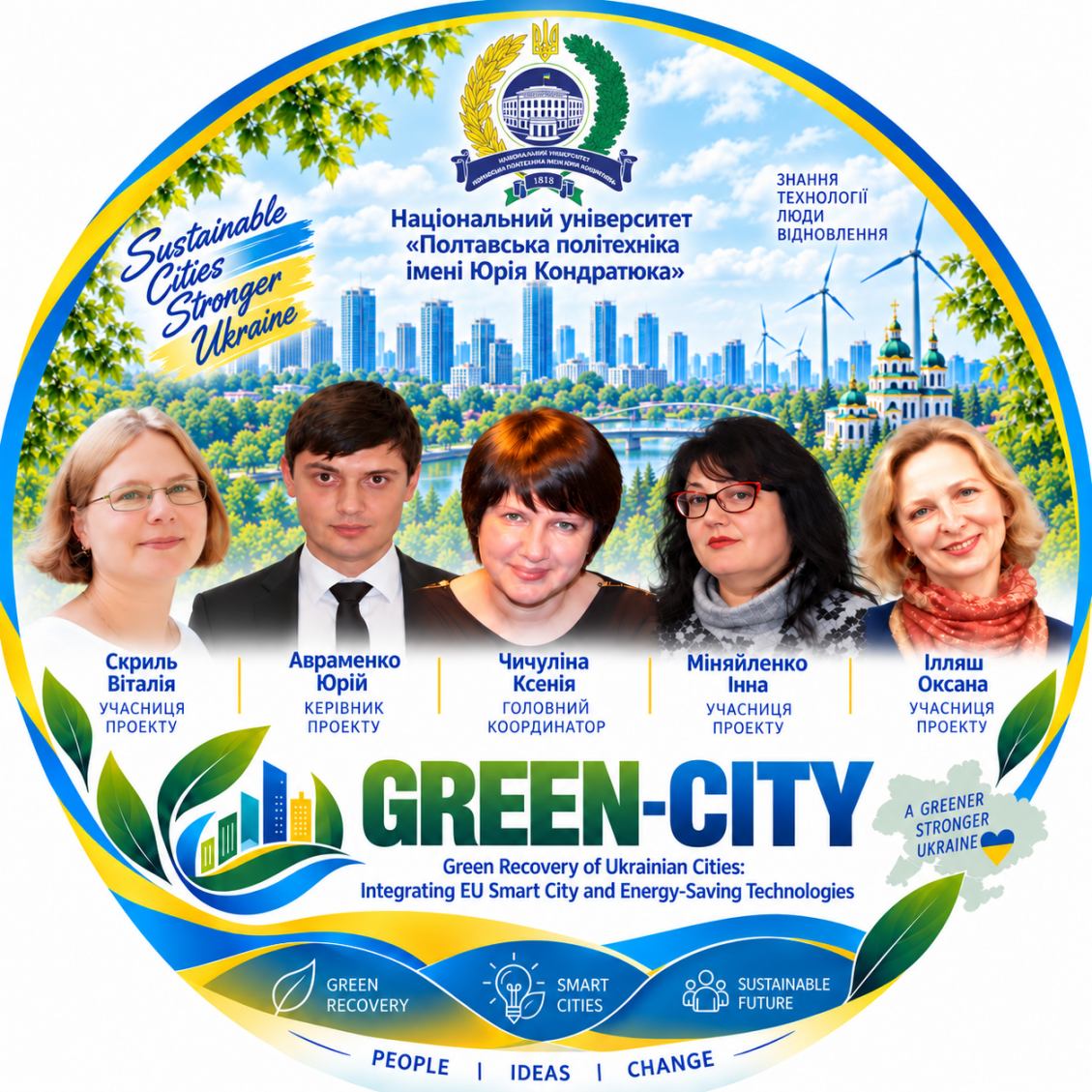
Another significant triumph for the university community came with the European Commission and the European Education and Culture Executive Agency (EACEA) announcing the results of the 2026 call for proposals under the Jean Monnet Action of the European Union's Erasmus+ Programme. Following a rigorous independent international evaluation, the project developed by Poltava Polytechnic researchers, titled “Green Recovery of Ukrainian Cities: Integrating EU Smart City and Energy-Saving Technologies” (acronym: GREEN-CITY), emerged victorious and was recommended for funding.
This year’s competition showed exceptionally high competitive intensity and global rivalry: of 2,223 applications submitted worldwide, only 327 initiatives were selected for funding. In the Ukrainian segment, out of 747 project proposals, only 40 applications succeeded through the competitive selection process, including 38 modules and two chairs. Poltava Polytechnic’s project achieved a stellar result, scoring 90 out of 100 possible points and earning the maximum 25 out of 25 points under the award criterion for the quality of partnership, competence, and research team synergy. To implement the three-year project, the university secured a grant allocation of 35,000 euros, joining the prestigious cohort of 29 Ukrainian higher education institutions that are shaping the contemporary European studies agenda.
The relevance of the initiative is driven by the urgent challenges of today, associated with the large-scale destruction of Ukraine’s urban, energy, and social infrastructure resulting from hostilities. Post-war modernisation of our state demands not simply mechanical restoration, but the implementation of a qualitatively new spatial development paradigm grounded in the leading European principle of “Build Back Better”. The project aims to systematically integrate the advanced standards of the European Green Deal, circular economy objectives, nearly zero-energy building (nZEB) concepts, the principles of the New European Bauhaus, and intelligent Smart City solutions and digital Building Information Modelling technologies.
The substantive core of the GREEN-CITY project is based on the synergy of cutting-edge engineering practices and modern information systems. The educational process will be closely tied to hands-on mastery of Building Information Modelling (BIM) technologies and the creation of Digital Twins of urban infrastructure. This will equip future engineers, architects, and managers with an advanced toolkit for digitally auditing damaged assets, accurately forecasting lifecycles, and minimising carbon footprints at the design stage.
Special attention will be paid to implementing circular economy principles, recycling and reusing construction and demolition waste, land reclamation, and developing standalone energy systems for critical infrastructure facilities. As a result, the project moves from abstract theory to concrete scientific and industrial workflows, adapting stringent EU decarbonization directives to the real-world conditions of rebuilding Ukrainian cities and towns.
The foundation of this success lies in a unique interdisciplinary team of authors, which brought together specialists in engineering, economics, and natural sciences from the Educational and Research Institute of Finance, Economics, Management and Law, the Educational and Research Institute of Architecture, Civil Engineering and Land Management, and the Educational and Research Institute of Oil and Gas and Energy.
Experienced scholars lead the team: Module Leader, PhD in Technical Sciences, Associate Professor of the Department of Civil Engineering Yurii Avramenko, and Academic Coordinator, PhD in Technical Sciences, Associate Professor of the Department of Economics, Entrepreneurship and Marketing Kseniia Chychulina. The project team also includes leading university researchers: PhD in Economic Sciences, Associate Professor of the Department of Finance, Banking and Taxation Vitaliia Skryl; PhD in Economic Sciences, Associate Professor of the Department of Economics, Entrepreneurship and Marketing Inna Miniailenko; and PhD in Technical Sciences, Associate Professor of the Department of Applied Ecology and Chemistry Oksana Illiash. Many years of successful implementation of previous Jean Monnet modules since 2018, coupled with consistent participation in EIB, GIZ, and Horizon 2020 projects, have earned the highest level of trust from European evaluators.
The GREEN-CITY module curriculum comprises 360 academic hours and envisions engaging over 400 higher education students majoring in environmental studies, energy, civil engineering, trade, and marketing. The comprehensive action plan includes developing and publishing two textbooks and two English-language collective monographs through European publishing houses, establishing an open multifunctional web platform with educational case studies, organising international research-to-practice conferences, round tables, and the flagship “Agents of Change” study visit. A vital social priority of the project is barrier-free access, inclusivity, and comprehensive support for veterans, combatants, and internally displaced persons to acquire new practical competencies in high demand in the labour market of a rebuilt Ukraine.
As noted by the project’s academic coordinator, PhD in Technical Sciences, Associate Professor Kseniia Chychulina, when developing the concept, the team sought to combine years of academic research and practical case studies in energy efficiency, smart technologies, and EU financial instruments to provide a systematic response to the complex challenges of modernising territorial communities. The researchers’ goal is to equip the Ukrainian economy with a new generation of professionals who have practical skills in harmonising national building and environmental standards with European Union directives.
The GREEN-CITY project's success is an organic continuation of Poltava Polytechnic's well-established, consistent grant-winning tradition, which has fostered an internationally recognised school of European studies. The university has built unique expertise in implementing a series of foundational initiatives under the EU Erasmus+ Jean Monnet Action. The strong foundation for this current triumph was laid by the successfully delivered projects “Energy Efficiency Challenges: Ukraine-EU Cooperation” and “Reforming the Environmental, Energy, Economic and Financial Spheres of Ukraine in the Context of European Integration”, which established qualitatively new benchmarks for teaching environmental management and energy security. We also contributed significantly to our country's resilience during martial law through effective work on the modules “Ensuring Environmental, Economic and Information Security: EU Experience for Ukraine” and “European Experience of Information Security and Data Protection Systems under Modern Conditions of Large-Scale Cyber Attacks”. This enduring institutional track record confirms the high level of trust from European partners. It demonstrates that every new grant awarded to the polytechnic rests upon deep academic continuity and systematic research achievements.
“On behalf of the entire team of authors and project participants, we express our most sincere, profound, and boundless gratitude to the President of National University “Yuri Kondratyuk Poltava Polytechnic”, Professor Volodymyr Onyshchenko, and the Rector of the University, Associate Professor Olena Fylonych, for their steadfast faith in our team's scientific potential, farsighted strategic leadership, and comprehensive support at every stage of preparing the international application. Volodymyr Onyshchenko's personal example, inexhaustible energy, and long-standing commitment to internationalisation and openness have transformed Poltava Polytechnic into a premier innovation hub in Ukraine, where academic boldness always finds a reliable pillar of support. At the same time, Olena Fylonych's attentive institutional care, sophisticated management culture, and daily, impactful support have created an exceptionally supportive and inspiring environment for researchers, where every academic initiative has every opportunity to be implemented to the highest European standards.
Thanks to the wisdom and synergy of the university leadership, Poltava Polytechnic has established a unique research ecosystem where winning highly competitive European Union grant calls is not a matter of chance, but a natural and celebrated tradition. This ongoing dedication to developing academic staff and a genuine commitment to the university’s intellectual authority inspire researchers to reach new heights. The GREEN-CITY project team deeply values the trust placed in us. It assures that we will dedicate our utmost efforts, knowledge, and professional expertise to the flawless execution of all module objectives, upholding the distinguished international reputation of our Alma Mater and making a meaningful contribution to the sustainable, smart, and energy-efficient recovery of Ukraine”, – stated Module Leader, PhD in Technical Sciences, Associate Professor of the Department of Civil Engineering, Yurii Avramenko.