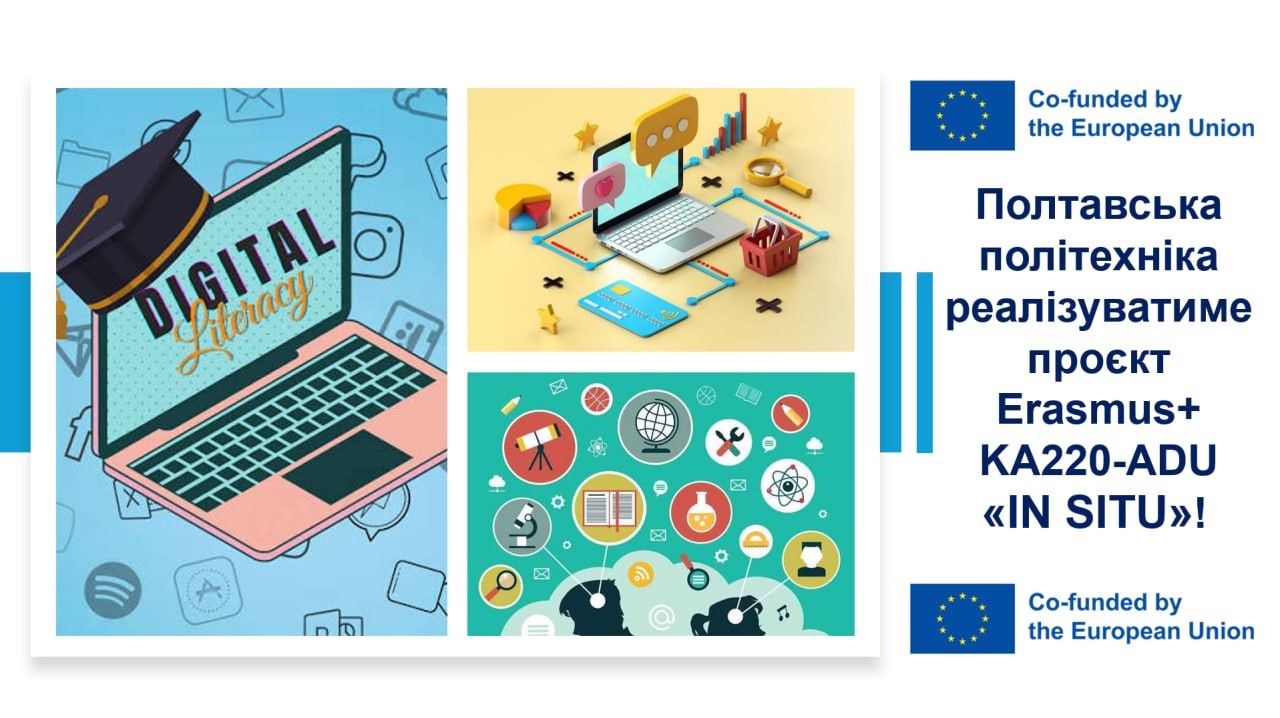
The “IN SITU” (Situated, inclusive and sustainable digital practices for adult education) project proposal, initiated and developed by our European partners with Haute Ecole Libre Mosane (HELMo, Belgium) as the lead coordinator, and co-funded by the European Union, has successfully passed the competitive selection for the Erasmus+ program under Key Action KA220-ADU – Cooperation Partnerships in Adult Education. This collaborative application, in which National University “Yuri Kondratyuk Poltava Polytechnic” participates as a partner, has been officially approved and funded by the European Commission. Currently, the university, alongside its international colleagues, is finalising the grant agreement in preparation for the official launch of joint activities at the end of this year.
The total project budget, scheduled for 36 months (from November 2, 2026, to November 1, 2029), is 400,000 euros (Poltava Polytechnic's funding share is 43,000 euros). The project received a high score from European experts (80 out of 100 points), who noted the thorough needs analysis, the topic's relevance, and the balanced nature of the partnership.
“IN SITU” builds on the results of a large-scale European survey (308 respondents across 5 countries), which revealed the so-called “paradox of superficial AI usage”. Although the vast majority of respondents (92,5%) regularly use conversational systems such as ChatGPT, only a meagre 4.9% utilise these tools for information structuring, automatic summarisation, or deep analytics. Furthermore, 40.9% of respondents admit that the operating principles of creative artificial intelligence remain completely incomprehensible to them. This confirms a critical need not just for technical training on “clicks”, but for fostering critical digital literacy that helps people better understand algorithmic logic.
Particular attention within the research was paid to the barriers faced by social educators, teachers, and instructors – specialists who help others master the internet. Approximately 75.5% of these specialists experience daily tension in their professional practice. Notably, this stems not from a lack of personal skills, but from structural conditions: an acute lack of time (41.3%), institutional pressure to use imposed software (33.6%), and a lack of adapted teaching methodologies (21%). The “IN SITU” project is designed to support specialists by providing ready-made, proven, and flexible tools.
The project aims to shift the focus of digital inclusion. Instead of simply teaching technical skills, the project will teach critical thinking in the digital space, personal data protection, and “digital sobriety” – an understanding of the ecological footprint of technologies.
Within the framework of the project, the consortium will develop three innovative products:
- Self-assessment framework (WP2) – a methodology for organisations to evaluate the sustainability and inclusiveness of their digital practices.
- Responsive online learning platform (WP3) – a mobile-friendly learning space with short modules on critical literacy and AI for social workers, educators, and adult educators (andragogues).
- Eco-inclusive pedagogical toolkit (WP4) – a unique set of offline tools for teaching critical thinking without using screens.
The methodological innovation of this package lies in the “offline-first” principle. Before opening a laptop or launching mobile applications, learning participants will undergo a physical experience: tactile cards, board games, role-playing scenarios, and group discussions. This approach deconstructs the perceived “magic” of artificial intelligence, helps overcome the fear of making a mistake (which, according to surveys, is the main mental barrier for many adults), and eliminates language barriers through clear visual icons and simplified instructions.
The project consortium includes six organisations from five European countries:
- Haute Ecole Libre Mosane (HELMo) (Belgium) – the main project coordinator, a leading higher education institution in the field of social work and pedagogy.
- Initiatives pour une formation efficace ASBL (Inforef) (Belgium) – experts in the development of digital platforms and eco-design.
- Association Regionale du Travail Social Hauts de France (A.R.T.S – IRTS) (France) – one of the largest training centres for social workers in France.
- Lekama Développement (Luxembourg) – a non-governmental organisation dealing with mental health issues in the digital era.
- Universitatea Aurel Vlaicu din Arad (UAV) (Romania) – a state university with strong expertise in social work.
- National University “Yuri Kondratyuk Poltava Polytechnic” (NUPP) (Ukraine).
Poltava Polytechnic has been assigned a highly responsible role in the project: our university will lead the second work package (WP2), within which our team will directly coordinate the creation of the indicator system and the development of criteria for organisational self-assessment. The process is divided into six interconnected stages: from baseline analysis and the development of the “Frugal Digital Learning Practices Index” to large-scale testing of the tool in at least 50 European organisations (at least 10 in each partner country) and subsequent open-access publication of the final reference manual. The university team will monitor data comparability and the tool’s methodological sustainability.
To implement the project, an interdisciplinary team of leading specialists from Poltava Polytechnic has been formed, bringing together experts in the fields of IT, pedagogy, and philology:
Anna Pavelieva – Project Manager, Poltava Polytechnic’s International Relations Coordinator; she will be responsible for the overall project management on behalf of our university, strategic communication, and compliance with the WP2 methodology.
Kseniia Verhal – Deputy Director of the Educational and Scientific Institute of Information Technologies and Robotics; an expert in cybersecurity and data modelling who will oversee the technical and ethical aspects of the platform.
Olena Dvirna – Head of the Department of Computer Science and Information Systems; she will coordinate the implementation of generative AI technologies and digital transformation within the project.
Olena Haitan – Senior Lecturer of the Department of Computer and Information Technologies and Systems; she will be responsible for the quality control of the platform and materials integration.
Tetiana Kushnirova – Professor of the Department of Germanic Philology and Translation, expert in pedagogical innovations; she will develop interactive learning formats and materials for the platform and offline games.
Anna Ageicheva – Dean of the Faculty of Philology, Psychology and Pedagogy; she will lead adult education and develop distance-learning approaches.
Alla Bolotnikova – Head of the General Linguistics and Foreign Languages Department; she specialises in differentiated instructional design and content personalisation.
Nataliia Bondar – Deputy Dean of the Faculty of Philology, Psychology, and Pedagogy; she will focus on developing critical media literacy.
The concept of sustainability and “digital sobriety” is integrated directly into the technological design of the project’s products. Unlike standard heavy platforms, the project’s web resource and LMS system are developed according to eco-design (eco-conception) principles. The program code will be optimised for minimal server energy consumption and page-load traffic, avoiding “heavy” CMS and redundant plugins. This will ensure fast and stable operation of the platform even on outdated smartphones or under weak mobile connection conditions, which is extremely relevant for Ukrainian users.
Strict adherence to the European Commission's official project management methodology, PM², ensures the successful implementation of this complex international program. This involves creating clear “quality gates”, where each prototype undergoes multi-level testing, evaluation, and user review before release. In addition, thanks to a shared risk management system (Risk Log), the consortium has developed business continuity plans in advance; in particular, a readiness to shift joint workshops to a virtual or hybrid format in the event of a complicated security situation in Ukraine has been declared, guaranteeing the stable fulfilment of obligations by all partners.
The integration of the Ukrainian partner during the period of martial law and recovery holds special value for the entire European community. Because of infrastructure instability, network access challenges, and equipment limitations, the Ukrainian experience will help make the developed tools as lightweight, autonomous, and viable in extreme conditions as possible.
Furthermore, Poltava Polytechnic students will be actively involved in testing and co-creating project materials, enabling them to acquire advanced European skills while still studying.
“The “IN SITU” project addresses extremely profound and highly relevant contemporary issues – not just teaching basic digital skills, but developing a conscious, critical, and ecological attitude towards technology. Today, as Ukrainian society and the educational sphere overcome unprecedented infrastructural challenges, sustainability, inclusion, and so-called “digital sobriety” have become a vital necessity.
We are sincerely grateful to our coordinator – Haute Ecole Libre Mosane (HELMo) – and to all the partners of the consortium for their trust, strong support, and the opportunity to co-create solutions that will bring real benefits to people in Ukraine and across Europe. Poltava Polytechnic is preparing to launch our activities with great responsibility and inspiration, particularly for the leadership in the second work package (WP2). We look forward to starting the active phase of our collaborative work at the end of this year”, – noted the project manager, Poltava Polytechnic’s International Relations Coordinator Anna Pavelieva.
Congratulations to the university team on this landmark achievement, and we wish them a successful launch of the project in the fall of 2026!
As a reminder, educators at Poltava Polytechnic can participate in academic mobility programs and internships. Students can study abroad under Erasmus+ credit academic mobility grant programs for a semester or an entire academic year at leading universities in Austria, Greenland, Denmark, Estonia, Spain, Lithuania, Latvia, Norway, the Netherlands, Germany, Poland, Portugal, Romania, Slovakia, Finland, and the Czech Republic.
For more detailed information regarding current internship, teaching, and academic mobility programs abroad, please get in touch with the International Relations Department (Room 213-C, interoffice@nupp.edu.ua) or the university’s International Relations Coordinator, Anna Pavelieva (+3-8-(095)-91-08-192).